
By Sonya Roberts, Legal Counsel at Nolan Heimann LLP
Twice now, the U.S. Copyright Office’s Review Board (“Board”) has told a claimant, in writing and in relation to an artwork made with AI, that a narrower registration was available to him. Both times, the claimant said no.
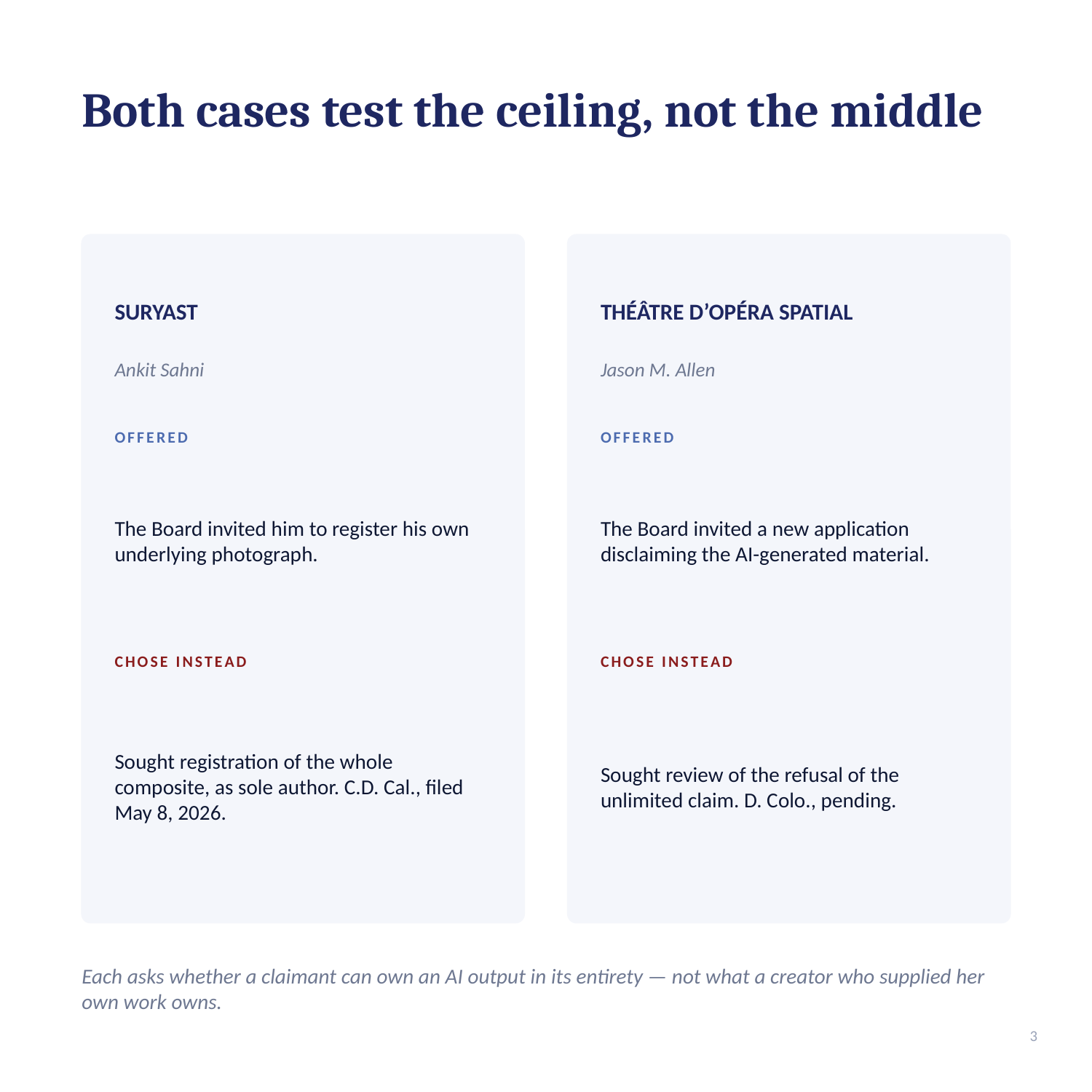
In December 2023, the Board refused to register SURYAST, an image the artist and intellectual property lawyer Ankit Sahni produced by feeding his own original sunset photograph, together with a public-domain image of Vincent van Gogh’s The Starry Night, into an AI application called RAGHAV. The Board went out of its way to note that Sahni’s photograph was “a separate work of authorship because it was fixed separately from the Work,” and added that he “is welcome to apply to register his photograph, assuming it meets all statutory requirements.”[1] He did not. He instead brought an action in federal court seeking registration of the composite in its entirety, with himself as sole author.[2]
Three months earlier, in September 2023, the Board had refused to register Jason M. Allen’s Théâtre D’opéra Spatial because the work contained more than a de minimis amount of Midjourney-generated material that Allen would not disclaim. The Board was explicit that its refusal “does not foreclose Mr. Allen’s ability to file a new application for registration of the Work in which he disclaims the Work’s AI-generated material,” in which case “the Office could consider whether the human-authored elements of the Work can sustain a claim for copyright, an issue we have not decided here.”[3] Allen did not file that application either. He sought judicial review of the refusal of the unlimited claim.[4]
Both these leading U.S. AI authorship cases now in the federal courts are maximalist challenges — they are looking for the legal ceiling. Each asks whether a claimant can own an AI-generated output in its entirety. Neither asks the question that most working creators — illustrators, photographers, musicians, designers and producers — need answered, namely, where a creator supplies her own protected work as the material on which the system operates, what nature and degree of human contribution will secure copyright in the result? That question sits in the middle of the doctrine, and the middle is where most of the commercial creative work happens. Because of how these two leading cases are framed, the courts will not be positioned to answer it.
What Sarony did and did not settle
The photography analogy (namely, that AI is a tool, much as a camera is a tool) has been well canvassed and carefully reviewed by Van Anh Le, who concludes that the analogy is “useful, but not definitive,” and by Kaiser, Song and Frankel, who use the same comparison to argue the opposite of what most practitioners assume: that photography’s originality bar has been too generous, and that AI images should receive copyright that is “exceedingly thin,” if any.[5] It is worth restating only because of what it does and does not decide.
When cameras first appeared in the nineteenth century, the objection was that a photograph was, as the defendant in Burrow-Giles Lithographic Co. v. Sarony put it, “the mere mechanical reproduction of the physical features or outlines of some object, animate or inanimate,” involving “no originality of thought.”[6] The Supreme Court disagreed, and it did not lower the originality threshold for the new technology. It found that Napoleon Sarony had produced his 1882 portrait of Oscar Wilde “entirely from his own original mental conception, to which he gave visible form by posing the said Oscar Wilde in front of the camera, selecting and arranging the costume, draperies, and other various accessories in said photograph, arranging the subject so as to present graceful outlines, arranging and disposing the light and shade, suggesting and evoking the desired expression.”[7] The Constitution was “broad enough to cover an act authorizing copyright of photographs, so far as they are representatives of original intellectual conceptions of the author.”[8]
So, Sarony stands for a narrower proposition than it is often credited with. It settles that originality resides in the author’s intellectual conception rather than in the medium, and it settles that a new technology does not disqualify a work. It says nothing at all about how much original conception is enough. On the facts, the Court did not have to ask that question, as Sarony controlled everything in his camera’s frame.
That gap matters, because the strongest academic objection to the analogy attacks precisely the point Sarony never had to decide. Tianxiang He argues that a user of a paintbrush or a camera “can intentionally select and shape virtually every element of the final image,” whereas the user of a text-to-image system does “not have comparable control over the initial image generated, or any final image,” and is left curating or editing after the fact.[9] He adds that extending copyright to such outputs is “an unwarranted windfall and a distortion of copyright’s incentive structure,” and that normalizing it erodes the authenticity copyright exists to encourage.[10]
He is correct where the human contribution begins and ends with a prompt. The argument has much less force, however, where the human contribution is not an instruction to the machine but the creator’s own protected work, supplied as the material on which the machine operates. That distinction is where the practical law is going to be made, and it is exactly the distinction neither pending case will test.
Thaler confirmed the outer limit
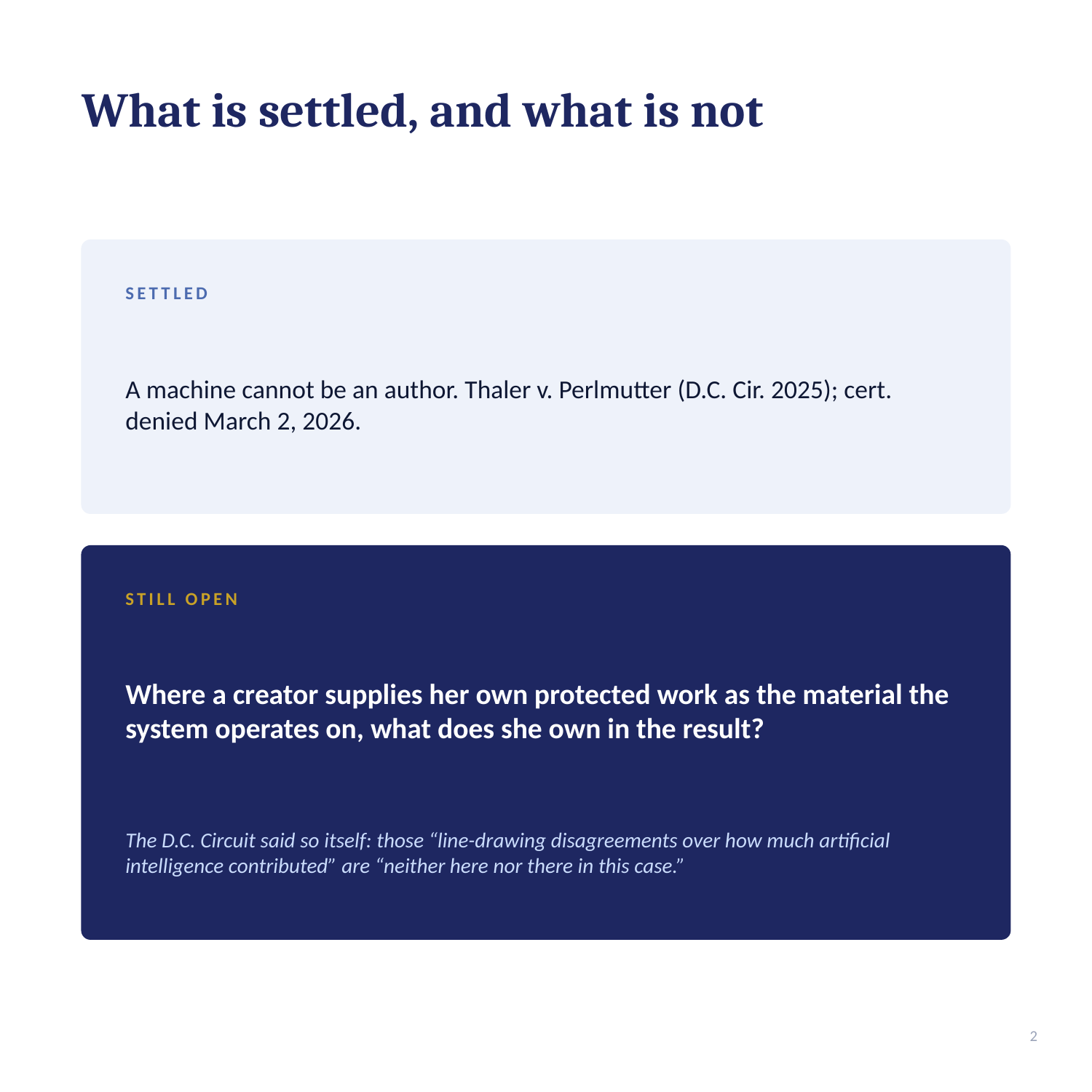
In Thaler v. Perlmutter, Dr. Stephen Thaler sought to register “A Recent Entrance to Paradise,” a work he said had been autonomously generated by his “Creativity Machine,” and named the machine as sole author. The Office refused, the District Court for the District of Columbia affirmed, and on March 18, 2025, the D.C. Circuit affirmed, holding that “[t]he Creativity Machine cannot be the recognized author of a copyrighted work because the Copyright Act of 1976 requires all eligible work to be authored in the first instance by a human being.”[11] On March 2, 2026, the Supreme Court denied certiorari.[12]
Thaler’s importance cannot be overstated as it settles that the human authorship requirement is law and not merely Office policy. But, as it was framed, it was an easy case. Dr. Thaler disclaimed human contribution entirely and sought protection for the machine. As one commentator put it, “Thaler asked whether nothing is enough. Allen asks whether a lot is.”[13] Commentators have been saying as much since early 2025, and I restate it here not as a discovery but as the premise for what follows.
The D.C. Circuit was also careful about what it was not deciding. The court observed that the human authorship requirement “does not prohibit copyrighting work that was made by or with the assistance of artificial intelligence,” and that “[t]hose line-drawing disagreements over how much artificial intelligence contributed to a particular human author’s work are neither here nor there in this case.”[14] The court that fixed the outer limit said, in terms, that it was not reaching the middle.
A Middle Ground?
The Office’s fullest statement on the registrability of AI-assisted work is Part 2 of its report on Copyright and Artificial Intelligence, published January 29, 2025 (“Report”).[15] The Report reaffirms the Office’s March 2023 registration guidance[16] (“Guidance”) and adds a framework for evaluation, including whether a human’s creative choices are identifiable in the output; whether the human controlled the expressive elements; and how much of the output must be disclaimed as AI-generated, all of which are to be assessed on a case-by-case basis.[17] The Office declines to recommend sui generis rights for pure AI outputs and concludes that existing doctrine is adequate.[18]
Three points from the Report deserve attention from practitioners.
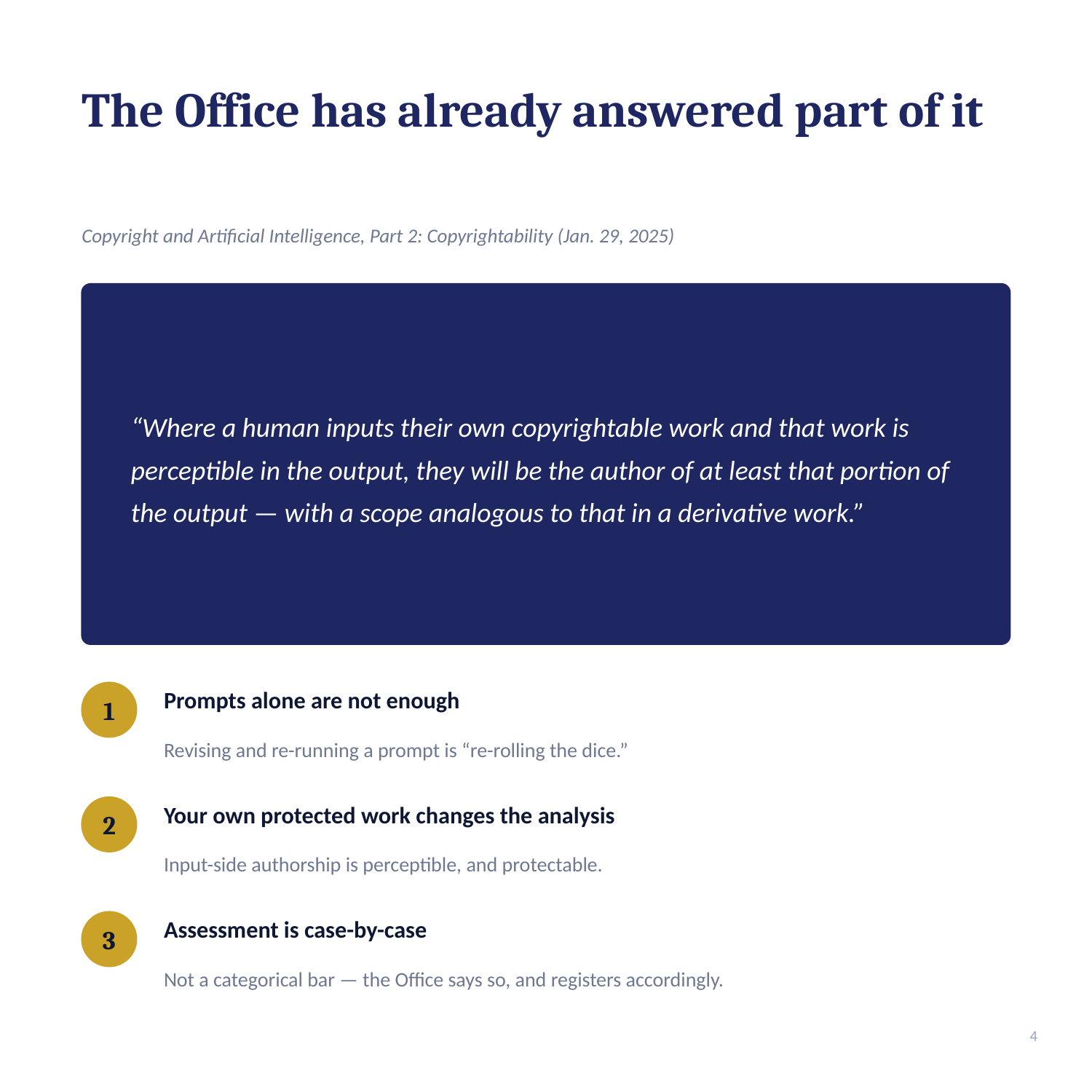
First, prompts alone will not do it. “[P]rompts alone do not provide sufficient human control to make users of an AI system the authors of the output.”[19] Revising and re-running a prompt, in the Office’s phrase, amounts to re-rolling the dice, and selecting among the options the system offers is not copyrightable authorship.
Second, the Office has already said that inputting your own copyrighted work changes the analysis. In its own words:
“[W]here a human inputs their own copyrightable work and that work is perceptible in the output, they will be the author of at least that portion of the output. Their own creative expression will be protected by copyright, with a scope analogous to that in a derivative work. Just as derivative work protection is limited to the material added by the later author, copyright in this type of AI-generated output would cover the perceptible human expression. It may also cover the selection, coordination, and arrangement of the human-authored and AI-generated material, even though it would not extend to the AI-generated elements standing alone.”[20]
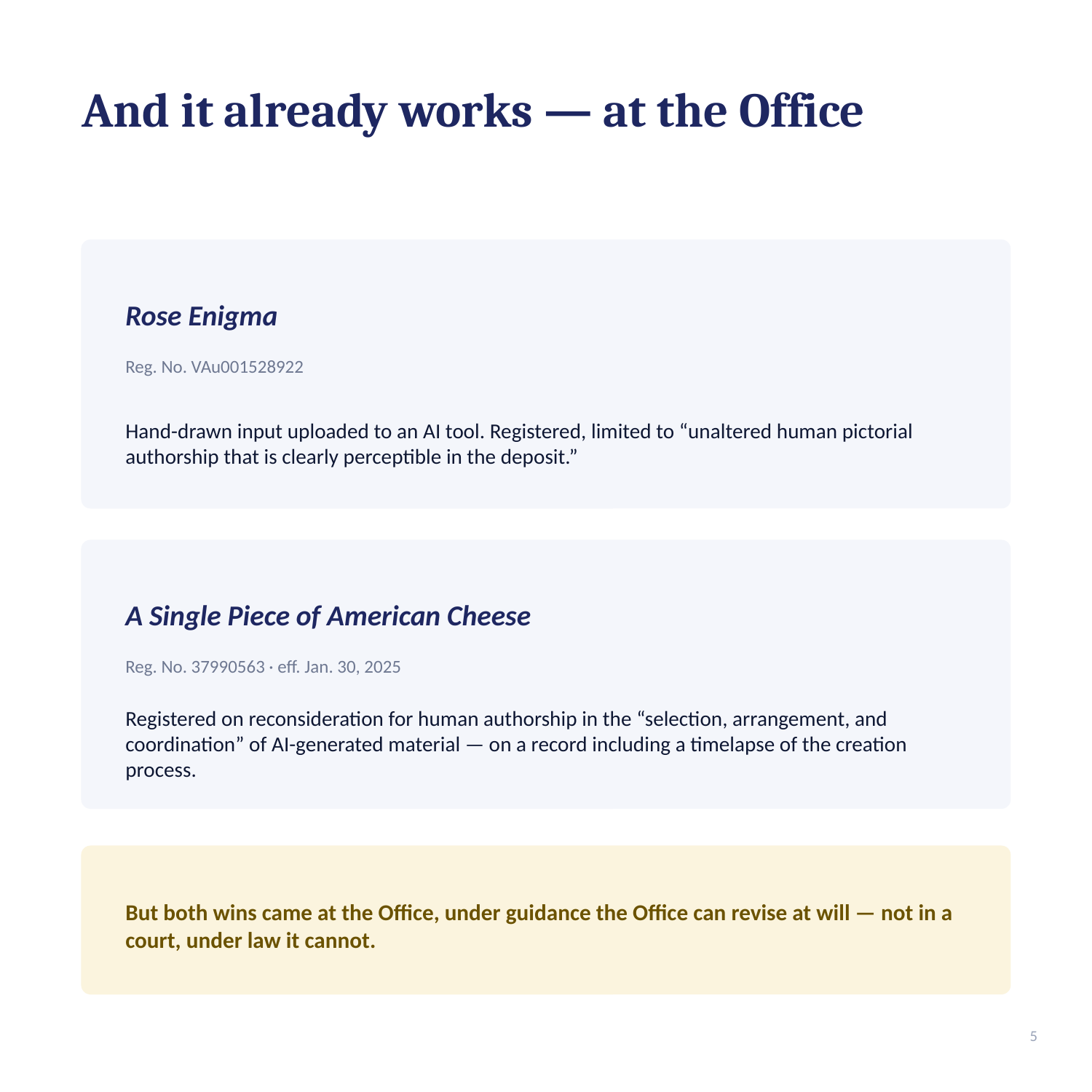
Third, the Office is applying its case-by-case framework. The Report’s own working example is a registered work, where an applicant uploaded a hand-drawn input, and the Office registered the result with the annotation “Registration limited to unaltered human pictorial authorship that is clearly perceptible in the deposit and separable from the non-human expression that is excluded from the claim.”[21] The Report expressly contrasts SURYAST, where the output did not “contain sufficient human authorship necessary to sustain a claim to copyright” because the applicant “exerted insufficient creative control over RAGHAV’s” generation of the output. Also, unlike Rose Enigma, the SURYAST output did not clearly show the copyrightable work input by the applicant.[22]
So, the case-by-case framework is not untested as a matter of registration practice. The Office has applied it and registered many works containing both human and AI material. What remains untested is how a court would apply it.
The Road Not Taken
In its SURYAST decision, the Board did not question that Sahni’s photograph was a separate, protectable work. It refused the composite because, having supplied only three inputs — Sahni’s original base image, a style image, and a “variable value determining the amount of style transfer”, Sahni “did not control where those elements would be placed, whether they would appear in the output, and what colors would be applied to them—RAGHAV did.”[23] Selecting a single number for a style filter was “the kind of de minimis authorship not protected by copyright.”[24]
Sahni rejected the derivative-work characterization, arguing that the photograph was not a separate work but “an early stage of what would ultimately become the Work,” like “a painter making a sketch before completing a painting.”[25] On May 8, 2026, his assignee filed an action in the Central District of California challenging the refusal as contrary to the text, history and purpose of the Copyright Act, and asking the court to order registration of the work in its entirety with Sahni as author.[26] Notably, the complaint frames the Office’s human authorship requirement as operating like a per se bar on registering anything made with AI — a characterization difficult to reconcile with a Report that prescribes case-by-case assessment and points to a registered example of the very input-side authorship Sahni was asserting. The complaint never sets the two against each other.
Allen follows the same pattern. The Board offered Allen a route to registration that required him to disclaim the AI-generated material. He declined this and sought review of the refusal of the unlimited claim instead. Cross-motions for summary judgment were fully briefed as of late February 2026 and remain pending as of this writing.[27]
That said, Allen may yet produce a holding on part of the middle ground. The Office’s cross-motion does not rest on the disclaimer alone; it asks the court to decide whether Allen authored the Midjourney output at all, arguing that “[t]he time and effort involved in creating a work is irrelevant in analyzing what aspects are eligible for copyright.”[28] If the court reaches that argument, it will say something about how much prompting is enough. But note what such a holding would, and would not, supply. Allen’s contribution is entirely prompt-side; he put no protected work of his own into the system. A ruling that several hundred prompts and subsequent edits fall short tells a creator who supplied her own copyrighted drawing nothing about her claim, which rests on perceptible human expression carried into the output. And a negative holding fixes a ceiling, not a floor, so we would learn what is not enough, not what is. The Office is itself careful to narrow the reach of the case, noting that it “does not concern newer generation AI models” and that determining authorship remains “necessarily a case-by-case inquiry.”
The pattern is worth pausing on. In both matters, the Office identified a route to registration that required the claimant to accept a limited claim. In both, the claimant declined it in favor of an unlimited one that also challenges the human authorship requirement itself.
The consequence is that the two cases fail in opposite directions. Allen has the posture but not the facts. In Allen, the court may reach authorship, but on a record made entirely of prompts and post-generative edits. Suryast has the facts but not the posture. Sahni supplied his own protected photograph, but he rejected the derivative-work characterization and seeks the whole of the work as sole author, so the claim that would have tested the input-side rule is not the claim before the court. Neither case will tell a creator who supplied her own protected drawing to the AI what she actually owns. Put differently, the Office’s case-by-case framework will remain untested in court not because the Office has refused to explain it, but because no claimant has yet put it in front of a judge.
The narrower claim and its limits
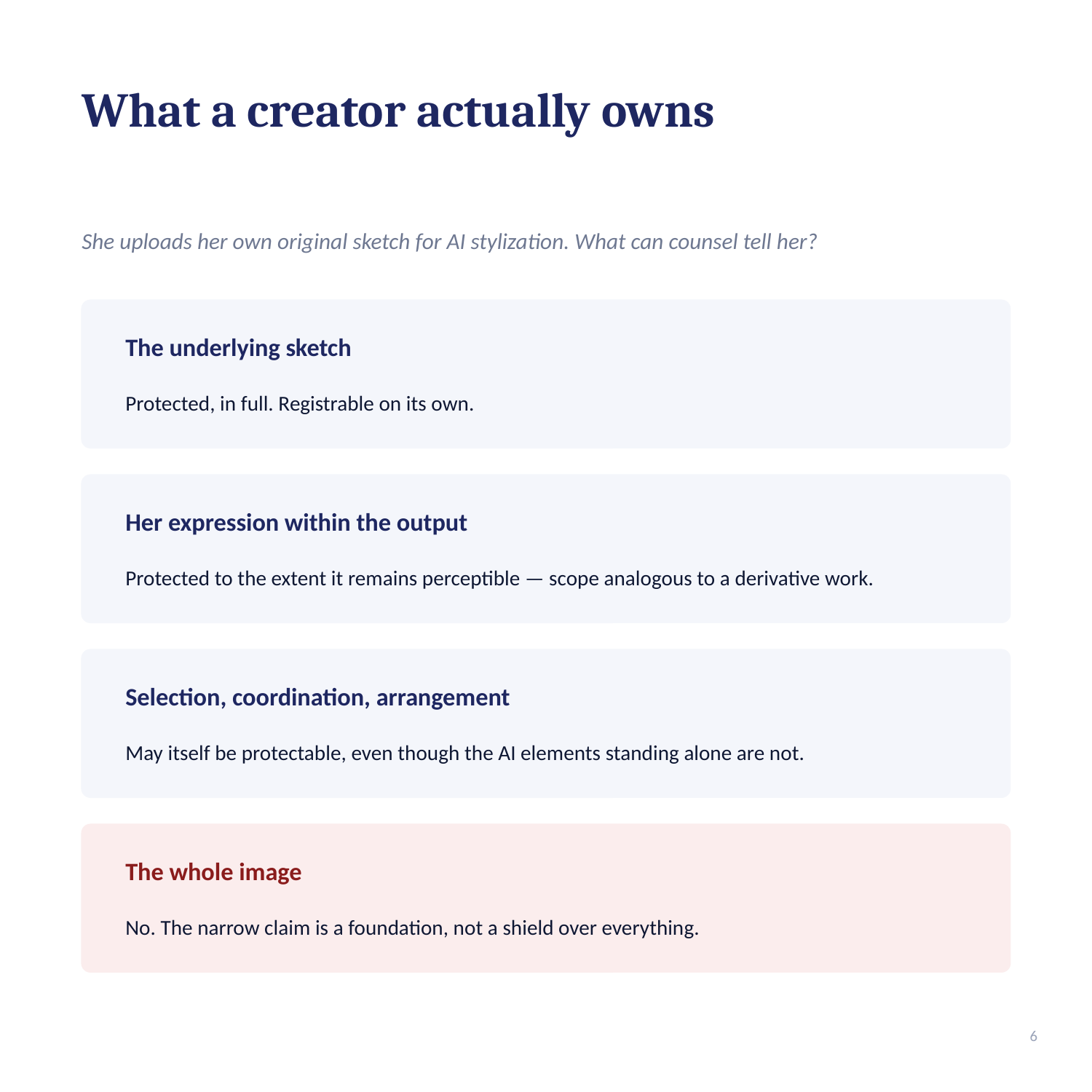
Consider the creator who uploads her own original sketch to an AI application for stylization. What can counsel tell her?
On the Office’s stated position, counsel can tell her three things. First, her original sketch is protected. Second, to the extent her original work remains perceptible in the output, her expression in the output is protected, with a scope analogous to derivative work protection. Third, the selection, coordination and arrangement of human and AI material may itself be protectable, even though the AI elements standing alone are not.[29]
Said another way, where a creator’s own protected work is perceptible in an AI-assisted output, she has (i) a claim in the output limited to her perceptible expression and, potentially, to the selection and arrangement, and (ii) a separate and independent infringement claim in the underlying work against anyone who copies the composite in a way that reproduces her protected expression. That second claim is often the commercially significant one. It does not, however, give her copyright in the whole image.
The burden on the Creator arises from the moment of creation
Whatever the courts do with the outer boundary, the immediate practical shift for creators has already happened. Copyright still vests on fixation, and a registration certificate still carries prima facie validity under section 410(c) of the Copyright Act. What has moved forward is the evidentiary burden. The facts that decide copyrightability under a case-by-case framework are process facts — what the creator supplied, what she controlled, and what she changed afterward. And process facts are available only to whoever preserved them at the time of creation.
The creative markers establishing authorship in Sarony — posing, costuming, lighting — must now find their equivalents in a documented process record: what was uploaded, what was generated, what was edited and how, and what was arranged and why. The Office’s Guidance already requires disclosure of more than de minimis AI content together with a statement of the human contribution.[30]
The Office has, however, supplied a working precedent for how much documentation is enough. On January 30, 2025, after reconsideration of an initial refusal, the Office registered A Single Piece of American Cheese for “a sufficient amount of human original authorship in the selection, arrangement, and coordination of the AI-generated material,” on a record that included a timelapse video of the creation process and an account of the applicant’s involvement.[31] That is what the evidentiary burden looks like in practice, and it makes the contemporaneous process record part of what the creator is really filing. It also complicates my own argument here, and I would rather say so than not: at least this claimant accepted a narrow, well-documented claim and won it. But the win came at the Office, under guidance the Office can revise at will, and not in a court, under law it cannot. That is the difference between a registration a creator can obtain today and a rule a creator can rely on tomorrow.
The same work, a different outcome
For Canadian counsel, and for anyone structuring cross-border productions, there is also a live comparative problem sitting inside the SURYAST dispute that is both legal and administrative in nature. The same image is registered in Canada. The Canadian Intellectual Property Office registered SURYAST on December 1, 2021, naming Sahni and the RAGHAV application as co-authors. That registration is now the subject of an expungement application before the Federal Court of Canada, brought by the Samuelson-Glushko Canadian Internet Policy and Public Interest Clinic and seeking rectification under section 57(4) of the Copyright Act. Memoranda of fact and law were filed in mid-2025, and as of this writing no hearing date has been set.[32]
Here we have identical facts, two registration systems in two jurisdictions, and opposite outcomes. That divergence raises a reliability problem for registrations generally. It also raises the prospect of conflicting registrations over the same asset, and of co-ownership disputes in international partnerships. For a co-production or a licensing chain that assumes a single global chain of title in AI-assisted assets, inconsistent registration outcomes will pose complex representation and warranty problems among the stakeholders.
Five practice points
Advise on the narrow claim first. Where the client’s own protected work is the base material, a limited registration disclaiming AI material is available and is very likely grantable. Treat it as a foundation, not a concession.
Do not promise a shield to the work as a whole. The realistic position is a limited claim in the output plus an independent claim in the human-authored underlying work.
Build the record at the point of creation. Retain the input files with dates, capture the generation and editing process, and keep a plain-language account of what the human decided. Assume you will have to prove it.
Assume prompts are worth nothing on their own. Where the client’s contribution is entirely on the prompt side, do not plan a registration strategy around it.
Check every jurisdiction in the chain. Registrability, and the consequences of a defective registration, currently diverge across jurisdictions on identical facts. Diligence, representations and warranties should reflect that.
Conclusion
When Napoleon Sarony posed Oscar Wilde in 1882, he was not merely operating a camera; he was arranging the costume, directing the gaze, controlling the light and drawing out the expression, and the Supreme Court treated those elements together as the essence of authorship. The question underneath today’s debate is recognizably the same one: when does a person using a tool cross from being a user to being an author? What has changed is not the question but the difficulty of proving the answer. More urgently, the leading cases now before the courts are not on course to answer it. Until someone litigates that question, the middle ground will remain a matter of Copyright Office guidance rather than settled law, and guidance, unlike law, can be revised at any time by the agency that wrote it.
Sonya Roberts is a Canada–U.S. entertainment and media lawyer and Legal Counsel at Nolan Heimann LLP. She advises on film and television production, intellectual property, copyright, and the intersection of AI and media.
Notes
[1] Letter from U.S. Copyright Off. Rev. Bd. to Alex P. Garens, Day Pitney LLP, Re: Second Request for Reconsideration for Refusal to Register SURYAST (SR # 1-11016599571; Corr. ID 1-5PR2XKJ) 5, 8 (Dec. 11, 2023) [hereinafter SURYAST Board Decision], https://www.copyright.gov/rulings-filings/review-board/docs/SURYAST.pdf; see id. at 8 n.9 (deposit requirements for such an application).
[2] Complaint, Suryast U.S. Enters., LLC v. Perlmutter, No. 2:26-cv-04999 (C.D. Cal. filed May 8, 2026) [hereinafter Suryast Complaint].
[3] Letter from U.S. Copyright Off. Rev. Bd. to Tamara Pester, Re: Second Request for Reconsideration for Refusal to Register Théâtre D’opéra Spatial (SR # 1-11743923581; Corr. ID 1-5T5320R) 8, 9 n.13 (Sept. 5, 2023) [hereinafter Théâtre D’opéra Spatial Board Decision], https://www.copyright.gov/rulings-filings/review-board/docs/Theatre-Dopera-Spatial.pdf. The Board also acknowledged at 8 that “human-authored modifications of AI-generated material may [be] protected by copyright,” but that “the Office cannot register Mr. Allen’s human contributions if he does not limit his claim with respect to the AI-generated material.”
[4] Allen v. Perlmutter, No. 1:24-cv-02665-WJM (D. Colo. filed Sept. 26, 2024).
[5] Van Anh Le, Copyright of Photography and Artificial Intelligence: A Tale of Two Technologies, 20 J. Intell. Prop. L. & Prac. 562 (2025), https://academic.oup.com/jiplp/article/20/8/562/8203364; Zoe B. Kaiser, Kanu Song & Simon J. Frankel, Reconciling Copyright Originality for Photography and Generative Artificial Intelligence, 49 Colum. J.L. & Arts 339 (2026), https://doi.org/10.52214/jla.v49i2.14631. On the longer history of copyright adapting to photographic technology, see Thomas B. Maddrey, Photography, Creators, and the Changing Needs of Copyright Law, 16 SMU Sci. & Tech. L. Rev. 501 (2013).
[6] Burrow-Giles Lithographic Co. v. Sarony, 111 U.S. 53, 59 (1884).
[7] Id. at 60 (third finding of fact). The photograph is identified in the report as “Oscar Wilde, No. 18,” id. at 54, and bore the notice “Copyright, 1882, by N. Sarony,” id. at 55–56.
[8] Id. at 58. The Court defined an author as “he to whom anything owes its origin; originator; maker.” Id.
[9] Tianxiang He, Three Obstacles to AI-Generated Content Copyrightability, 2026 Sing. J. Legal Stud. 77, 82–83 [hereinafter He, Three Obstacles], https://law.nus.edu.sg/sjls/wp-content/uploads/sites/14/2025/10/FV_SF_HeT.pdf; see also Tianxiang He, AI Originality Revisited: Can We Prompt Copyright over AI-Generated Pictures?, 73 GRUR Int’l 299 (2024).
[10] He, Three Obstacles, supra note 9, at 90–91 (windfalls), 96–103 (broader impacts, including authenticity at 101–02).
[11] Thaler v. Perlmutter, 687 F. Supp. 3d 140 (D.D.C. 2023), aff’d, 130 F.4th 1039, 1041 (D.C. Cir. 2025).
[12] Thaler v. Perlmutter, cert. denied, No. 25-449 (U.S. Mar. 2, 2026).
[13] Aaron Moss, Thaler Is Dead. Now for the AI Copyright Questions That Actually Matter., Copyright Lately (Mar. 9, 2026), https://copyrightlately.com/thaler-is-dead-ai-copyright-questions/. For the same framing in practitioner commentary, see Hugh Warren & W. Whitaker Rayner, With Thaler Closed, Courts Must Now Turn to the Harder Question of AI-Assisted Authorship, Jones Walker AI L. Blog (Mar. 19, 2026); and, in the journals, Howard A. Skaist, Copyrightability and Scope of Protection for AI-Assisted Works — The Unaddressed Middle, 66 IDEA 235 (2026).
[14] Thaler v. Perlmutter, No. 23-5233, slip op. at 19–20 (D.C. Cir. Mar. 18, 2025), https://www.copyright.gov/ai/docs/court-of-appeals-decision-affirming-refusal-of-registration.pdf.
[15] U.S. Copyright Off., Copyright and Artificial Intelligence, Part 2: Copyrightability (Jan. 29, 2025) [hereinafter Report], https://www.copyright.gov/ai/Copyright-and-Artificial-Intelligence-Part-2-Copyrightability-Report.pdf.
[16] Copyright Registration Guidance: Works Containing Material Generated by Artificial Intelligence, 88 Fed. Reg. 16,190 (Mar. 16, 2023) [hereinafter Guidance]. The Office there stated that “[w]hen an AI technology determines the expressive elements of its output, the generated material is not the product of human authorship. As a result, that material is not protected by copyright and must be disclaimed in a registration application.” Id. at 16,192. The earliest application of that position was the Zarya of the Dawn determination, in which the Office registered the author’s text and the arrangement of images but not the individual Midjourney-generated images. Letter from U.S. Copyright Off. to Van Lindberg, Taylor English Duma LLP, Re: Zarya of the Dawn (Registration No. VAu001480196) 2–3, 9–10 (Feb. 21, 2023), https://www.copyright.gov/docs/zarya-of-the-dawn.pdf.
[17] Report, supra note 15, at ii–iii, 11–27.
[18] Id. at 36–37, 40–41.
[19] Id. at 18; see id. at 18–21.
[20] Id. at 24; see id. at 22–23 (expressive inputs).
[21] Id. at 23 (describing the registration of Rose Enigma, Reg. No. VAu001528922 (March 21, 2023)).
[22] Id. at 23 n.124.
[23] SURYAST Board Decision, supra note 1, at 7.
[24] Id. at 8 (citing Feist Publ’ns, Inc. v. Rural Tel. Serv. Co., 499 U.S. 340, 359 (1991)).
[25] Id. at 3 (summarizing Sahni’s argument); see id. at 5 (holding the photograph a separate work of authorship).
[26] Suryast Complaint, supra note 2. The plaintiff is Sahni’s assignee; the relief sought nonetheless asks that the work be registered with Sahni as the author.
[27] Plaintiff’s Reply in Support of Motion for Summary Judgment and in Opposition to Defendant’s Cross-Motion, Allen v. Perlmutter, No. 1:24-cv-02665-WJM (D. Colo. Feb. 27, 2026), ECF No. 60. No merits ruling had issued as of the date of this article.
[28] Defendants’ Response to Plaintiff’s Motion for Summary Judgment and Cross-Motion for Summary Judgment, Allen v. Perlmutter, No. 1:24-cv-02665-WJM (D. Colo. Feb. 6, 2026), ECF No. 58-1, https://www.copyright.gov/ai/docs/us-reply-brief-and-cross-motion-for-summary-judgment.pdf. The observation that the case “does not concern newer generation AI models” appears at n.7; the “case-by-case inquiry” language quotes the Office’s AI Registration Guidance.
[29] Report, supra note 15, at 24.
[30] Guidance, supra note 16, at 16,192–93.
[31] A Single Piece of American Cheese, Reg. No. 37990563 (eff. Jan. 30, 2025); see also U.S. Copyright Office Grants Registration to AI-Generated Artwork, Harv. J. Sports & Ent. L. (Mar. 2025), https://journals.law.harvard.edu/jsel/2025/03/u-s-copyright-office-grants-registration-to-ai-generated-artwork/.
[32] Canadian Intell. Prop. Off., Copyright Registration No. 1188619 (Dec. 1, 2021) (Can.); Samuelson-Glushko Canadian Internet Pol’y & Pub. Int. Clinic (CIPPIC) v. Sahni, No. T-1717-24 (Can. Fed. Ct., Notice of Application filed July 8, 2024) (seeking expungement or rectification under Copyright Act, R.S.C. 1985, c. C-42, s. 57(4) (Can.)). Memoranda of fact and law were filed June 26, 2025 (CIPPIC) and July 16, 2025 (Sahni); see CIPPIC v. Sahni, https://www.cippic.ca/our-work/cippic-v-sahni.