
Every Deal Is a Dance Ep. 10: From Dishwasher to Empire Builder: Chef Gavan Murphy on Food, Hospitality, and Creative Entrepreneurship

Gavan Murphy will tell you he's not a chef. He's someone who connects people through food. It's a distinction that may sound subtle, but it's the foundation of everything he's built — from a small-town upbringing in County Kerry, Ireland, to personal chef work for celebrities and athletes in Los Angeles, to co-founding the Healthy Irishman Catering Company in Las Vegas alongside his wife and business partner, Christy.
In this episode of Every Deal Is a Dance, host Mishawn Nolan sits down with Gavan for a conversation that moves fluidly between food philosophy, entrepreneurial grit, and personal values. Gavan traces his path from washing dishes at a busy Edgartown restaurant during a Martha's Vineyard summer to attending culinary school in Ireland, to spending seven years building a pecan butter product line — getting it into Whole Foods and Erewhon — before making the clear-eyed decision to close it and double down on hospitality.
What emerges is a portrait of a creative entrepreneur who operates from a deeply consistent set of values: be genuine, be generous with your time, and never let what's happening behind the scenes compromise what the guest experiences in front of you. Gavan talks about the difference between service and hospitality — one is tangible, the other is a feeling — and why he believes that distinction is what sets his business apart.
He also speaks candidly about the loneliness of entrepreneurship, the value of a partner who can hold steady when you can't, and what he's actively teaching his son Dylan about building something of your own. This is Alignment and Flow in action — not as a theory, but as a lived practice.

Every Deal Is a Dance Ep. 10:
Podcast Transcript:
Announcer: You're listening to Every Deal Is a Dance, part of the Look Legal pods from the law firm Nolan Heimann. And now, here is your host, Attorney Mishawn Nolan.
Mishawn Nolan: I'm Mishawn Nolan and I'm co-founder and co-managing partner of Nolan Heimann LLP. Before I was a lawyer, I was a dancer and then I was a choreographer. And so, it's not surprising that my law practice reflects dance principles of alignment and flow, especially when I'm working with my clients to monetize their creative ventures. And essentially what it means is aligning your abilities with your goals while at the same time balancing structure and reinvention. I want to make growing businesses less scary and less overwhelming for creators. So, everyone I interview in this series is someone who has a story to tell about authenticity, about their reinvention and their journey as a creative business maker. It is an opportunity to hear stories of alignment and flow in action.
Sometimes you find alignment by breaking the rules. And that is the story of my guest today. I first met Gavan Murphy 15 or 16 years ago. He was a fascinating mix of contradictions. Originally from Ireland, living at the beach in LA, respectful yet irreverent, loving husband and father, but looks like he will kick your ass. Tough guy, but a softy, hyperactive yet focused. And on top of everything, he's the healthy Irishman. When I think of Ireland, I don't think of healthy food. I think of all the sausages I ate when I was there, the corned beef and potatoes I have on St. Patrick's Day, Irish cheese, bread, Guinness, hearty food that sticks to your bones because it's so cold over there. Gavan turns it all on its head. He's a personal chef, including for celebrities, top athletes and supermodels who have the greatest bodies in the world.
But he's not a cook, he creates experiences. Currently residing in Las Vegas, he, along with his wife and business partner, Christy, operate the Healthy Irishman Catering Company, and they curate tailored culinary experiences that you can feel good about eating. Gavan is a rule breaker, but he operates in alignment because underneath it all is a very clear set of values that drives his decisions and highly trained skills that anchor his business efforts.
Gavan, welcome to the Every Deal Is a Dance podcast.
Gavan Murphy: Thank you, thank you. What an introduction. That was amazing. That was my whole life right there. I can just put that on my tombstone, hopefully not for a long time. And that's me in a nutshell. Yes.
Mishawn: I'm glad I captured it. So, take us back to your early years. What was your relationship like with food growing up?
Gavan Murphy: Growing up in an Irish family, food and meal time was very much the center of our day. I'm going back 55 years or so when, you come home from school - I grew up in a small town on the southwest coast of Ireland in County Kerry. We would go to school every day. My father worked. My mom was a housewife, but every evening we would have dinner. There was dinner time at six o'clock.
And that's what we did. And we caught up with the day and just sort of spent time as a family. Food to me has always been about creating a moment for me. It's my connection to my parents who are both deceased. Unfortunately, my sisters who both live in Ireland, my younger brother lives in New Zealand. So, for us, it was a time to connect even just for that half an hour until we wanted to run off and watch TV. But that was important of course, it's pre cell phone. So those are the distractions like that. Right. It was dinners ready. We sat down. We had dinner. How was your day? And that's really was the focus of my connection to food back to childhood in terms of how I sort of related to food. I loved food. I still love food. I loved food so much that I consumed copious amounts of it and not the good type.
So, I was overweight as a child all the way into my teenage years until about when I turned about 15, 16, I started to grow and sort of develop. But I also started to correlate exercise with how I felt. And obviously, playing sports, I played rugby as a child and then there was a summer, remember it very, very clearly. I was 15 and I took up cycling for no apparent reason. And to take up cycling in Ireland means that you must love to get wet because it rains every day. But my father bought me a bike and I would cycle every single day, miles upon miles. I just loved it. And it actually, in looking back to it now, it sort of speaks to my personality.
I consider myself, as my adulthood sort of came to play, but I consider myself a social introvert. I love spending time by myself and I think cycling spoke to me that way because I would just spend two, three hours cycling by myself and my own thoughts. And I loved it. But I saw then a direct correlation when I went back to school that my body was sort of developing because I had been doing sort of exercise. I did not understand at that time the correlation between food, in terms of nutrition and exercise. But just I just started to understand more about, oh, if I exercise and I do this, I can start to look a certain way. But food has always been a very much an integral part of my person, of my being.
Mishawn: And what happened, how did you know that instead of just enjoying food and enjoying the experience of eating with other people, that you wanted to make it your profession?
Gavan Murphy: So that was interesting. I literally never interested in cooking. I loved eating and I could do that. I always worked in hospitality for my summer jobs. I worked as bartenders, as a waiter, but never in the kitchen because the kitchens when I was growing up was very much the sort of old boys network, right? You couldn't just go in and get a summer job in a kitchen that, you know, you just wouldn't be hired, right? And people went to culinary school. So, my father was in the insurance business and in auctioneering, as we call it, real estate. So, he sort of wanted me to go in that direction. I never saw myself as fitting in, in a nine to five, putting on a suit every day, sitting in an office. It was just never part of my journey.
I didn't know where my journey was going to go at that stage. Then I was interested in getting to hotel management, which was about as close as I was getting to where I am now in terms of my career. So, I ended up going to marketing business school and I ended up going there because two of my best friends went there. So, we all went to college together. We all lived together. We did that college thing was fantastic, had a great time. And in my third year of college, I was 22. I spent a summer in Martha's Vineyard with one of my roommates and I ended up in the kitchen of a very busy restaurant in Edgartown washing dishes. And I know a lot of chefs or people in the culinary world, a lot of people start as a dishwasher and it was probably the best place for me to start. I got into that kitchen. I'll never forget it. And just the craziness and the hustle and bustle. But I also really sort of resonated with the hierarchy in the kitchen.
And there were sort of levels to that, because I'm quite regimented in my day to day and that really sort of spoke to me. So, I was there for four months. I washed dishes, had a great time, went back to my college, did not finish college at all and went to a culinary school in Ireland knowing that I wanted to learn about food. I knew that that part of the industry, sort of, you know for me was the cockpit of the jet, was the kitchen. Everything comes from the kitchen, not understanding the service side of it. I hadn't got into that yet. Understanding that there are levels in the kitchen and the production and the attention to detail and all of that comes from the kitchen of a restaurant. And that's what I wanted to focus on and went to a culinary school, which was 25 years ago. And we're still at it.
Mishawn: So how would you introduce yourself today? How do you introduce yourself?
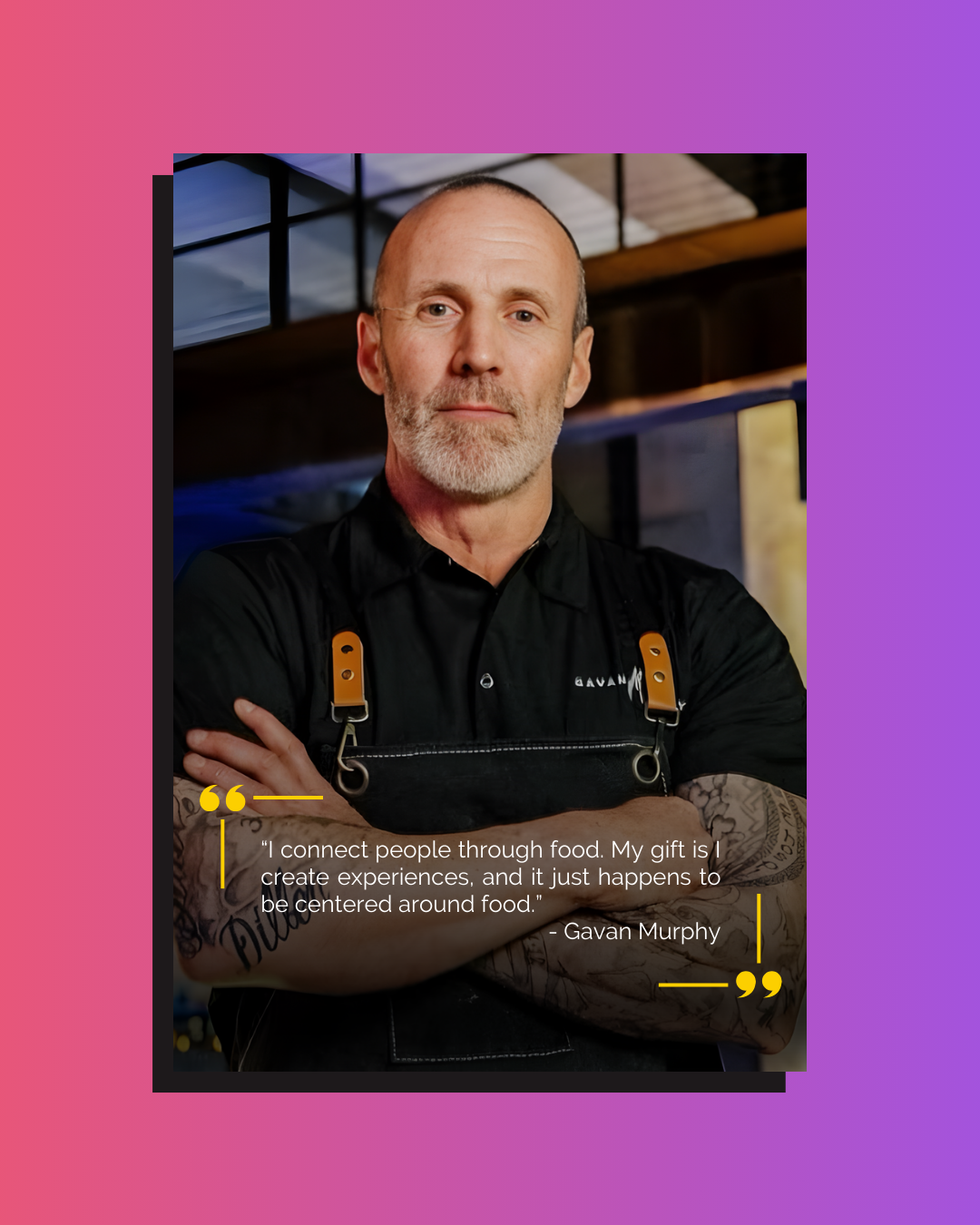
Gavan Murphy: I'm very cognizant of throwing out titles, right? People ask me what I do. And we've spoken about this many times - what you do is not who you are, right? I always referred to myself, referred in the past as a chef, right? But that's what I do as opposed to who I am, right? If people say, what do I do? I tell them that I connect people through food. That's what I do. My gift, if you will, and I use the term loosely, but my gift or my talent is I create experiences and it just happens to be centered around food. And again, that goes all the way back to my journey at the beginning. And that's really what I consider myself. I consider myself a person who has a talent for building rapport with people and the tangible vessel that I use for me is cooking.
Mishawn: And what were the hardest skills for you to learn? So, you started washing dishes in the kitchen, you went to school for it, but what was really hard for you to learn?
Gavan Murphy: I think one of the hardest challenging parts of my journey was really dealing with people. There's a lot of personalities involved. Typically, chefs and you know, I almost don't like to use the term because it's like it's, it's a title. Right. But chefs, some chefs, have egos. Right. And that's not surprising. Yeah.
Mishawn: I’ve heard that.
Gavan Murphy: And I really just don't. I just don't because I'll do whatever needs to be done. I think it's because of how I went to culinary school and I just did everything. I didn't go to culinary school with the big, vision of becoming a chef and, I have the jacket and I have this and that. To your lovely introduction you gave me, I don't like fitting in a box. I don't see myself in any sort of restrictions. I can do whatever, right? But I love the fact that I get to work with other people and I get to motivate and inspire and not so much to my food, just in general. I just really enjoy being in an environment where we're all working together to create this masterful experience for my clients or for whoever we're working for at that time. But the biggest challenge was really sort of trying to manage that and understand that. And also, you know, to be honest, sometimes when you're trying to create something, people don't see your vision, right? And you sometimes, you know, you might be hesitant to sort of say what you're trying to do.
I've always said I'm trying to create, you know, I'm building an empire. I've always said that, I've had no problem saying that. But maybe having the confidence to say that – that was a challenge because you don't want to sound stupid. You might be judged by people. Now I'm at an age where I could really give a fuck about it because I am who I am, I care about what I do and I've been fortunate enough to work with some amazing people who sort of are on board with what we're trying to create.
Mishawn: Did you have any mentors? Or did you do this on your own?
Gavan Murphy: I mean, you never do it by yourself, right? I've had mentors, I wouldn't say mentors in the culinary sense. for me is just someone who I can learn from, someone that I see they have a gift or they have a style and what they do.
And I want to learn from them. Right. So, I'm always trying to learn. So, mentors, not specifically in my, in my, culinary journey. But I'm saying this for no other reason than it's true, but I've had many mentors. You and I have known each other for 15 years or so, and you and I've had multiple conversations and I call you randomly when I have a harebrained idea, not having spoken to you for a few months.
You're absolutely a mentor of mine because otherwise we, still wouldn't have this connection 20 years later. I mean, I have a number of different people that have been part of my journey that I just connect with and I want to learn all these nuggets. I'm not trying to learn specifically for the food industry. I'm trying to learn for business and for personal and for marriage and for fatherhood. All these, I have multiple people who have played a role in that because it's all correlated, right? You can't just be fantastic at business and you might be an average husband or an okay dad or, the friendship. I'm trying to master all of them, right? Listen, it's a challenge, right? You, you know, I'm always trying to be inspired by others. And I'm also trying to be inspiring at the same time.
Mishawn: You described that one of your challenges used to be expressing yourself, expressing exactly what it is you wanted to do. I want to build an empire and that's who you authentically are, right? And, and how you connect with people, that's how you authentically are. It is absolutely related between business and personal, who you are, who you authentically are. It expresses itself in your personal life and in your business life. And so. I agree with you, that's part of my theory is you have to be in alignment with who you are. So, you can't be a terrible person and be excellent in business. It doesn't work that way.
Gavan Murphy: Of course. I agree. I agree. I mean, you know, you hear or have heard that, who's made it to the top has obviously fucked over many people. That's not the case. It might be the case for a certain person, but it doesn't have to be the case. You don't have to be, unkind or hostile or rude, or whatever it is you want to pick. You don't have to be that person in order to be successful. You can be a good person and just be great. And I feel like you'd probably get more out of people if you're not trying to fuck people over all the time. But again, to your point, you have to be 100 % authentic in who you are. And if that's who you are, that's who you are, you own it. But that's not who I am. And that's not what I'm trying to portray. But that also correlates, and it transfers in how I want to be as a husband and a dad. I want my son to learn from me that you can be a good person you can work hard and you can achieve it, but by being kind and being respectful and helpful and giving and all of these things to other people. All of those good traits can occur and you can still get there without trying to get one over on anybody, right? And again, I learned that from my father who was in business for himself, and I learned how he was respected and how he communicated with people. And that's how I learned it. And that's what I'm looking to transfer that down to generations.
Mishawn: So, you are known for healthy food, right? Not just great food, but healthy food. How would you define healthy food?
Gavan Murphy: Healthy food to me is, if you tell people you cook healthy food and I don't specifically label what I do, but again, it goes back to who I am and how I live and how I'm authentic in terms of - I like to eat clean. I like to eat nutritious food. I like to exercise. I like to have that balance for longevity purposes, right?
Although I would be more known for cooking healthier food, I still have a business to run. Right. So, I can't just say, yes, I'll do an event for you, but we have to have kale Caesar salad and grilled chicken. I'm not going to be in business too long. That might be one or two clients. Right. So, I have to be flexible. However, I do translate my style of cooking, which is more on the cleaner aspect of it. I don't use processed foods. I don't typically cook with seed oils. I'm using quality ingredients- my clientele expects that. I think a lot of people now expect that, right. They don't want to have processed foods. But I like to emit sort of a message that I'm trying to get across through how I live, right, because I live that lifestyle. So, it's easier for me to cook and to be that person rather than you might see someone who tells you that they cook healthy and that they're into exercise, but they’re looking at you they're going, I'm not too sure that's true. You have to be authentic in what you do and you know what mean? So, I just translate that. I've been very fortunate that I've got a clientele who are similarly minded to me, right? They want to have that sort of lifestyle. And luckily, they keep calling me, which is nice.
Mishawn: Yeah, I think it makes sense that your clients would have similar values to you, right? I think that's the case for me. I think that most of my clients, not all my clients, but I think most of my clients share my values because you connect, you relate, you have North stars that align. So, it makes perfect sense.
Gavan Murphy: But I think you have to have that and that translates outside of business that translates into friendship. It translates, you know, and obviously the older we get, my tolerance for being around people who are not similarly minded to me in terms of values and, mindset and such, I don't want to put myself, you know, I only want to people around me who, sort of want to lead a similar lifestyle and might have similar sort of values in terms of marriage and parenting and business and such. But these people will be attracted to you and likewise, because if you're emitting exactly what you care about and you talk about it, then the right people will come into your life.
Mishawn: Yeah, so if I was speaking to some of your closest friends and clients, what would they say about you? What do value?
Gavan Murphy: Boy, I need to bring my wife into this one. She'd be a better judge. What would people say about me, Miss Christy, in terms of my values and what I stand for? I think the number one thing they would say is I am genuine, I have no problem sort of just saying what I think, which is not always a good thing, but it's a good thing if they're a close friend, you have to say what you mean, otherwise you're not really a friend. I'm, I'm quite direct. I can be quite blunt. And these are not any surprise to you over the years.
My wife said generous. Generous maybe with time, outside of, you know, financial. Otherwise, I'll tell you an interesting story. So, when my father passed, which in 2018, is was just before we moved to Las Vegas, we were at removal, which is before the funeral, the night before the funeral where the coffin is in the funeral home and people can come and pay their respects.
And I can tell you the amount of people that came up to me, people I'd never met before, clients of my father's and said, your father was most generous person with his time with me. Like he was known for… if he was walking down the street of the town, he saw somebody he knew on the other side, he would walk across to talk to them and to say hello, just something like that. One of the most valuable commodities we have is our time. And if you can give up and you're willing to give up your time for nothing in return just because you care about a person or there's a cause that you believe in or whatever it happens to be. And that's something I learned from my father. Absolutely. I think probably the biggest thing people would say that I just don't take any shit, I think. I mean, what have I got to lose at this stage of the game?
Mishawn: It's the gift of getting older.
Gavan Murphy: Family man, and witty, my wife told me. I'm not sure about the witty. I think I'm witty, I don't know if I am or not.
Mishawn: You at some point made an entrepreneurial shift, right? Why did you do that and how did you do that?
Gavan Murphy: Yes. I was always destined, to create my own journey. I was never going to be someone who was going to have that nine to five job, checking in, clocking in, clocking out. It was never part of my journey. I never ever saw it as part of my journey. There's a festival in my town every year. It's still on. It's an international beauty pageant and people can come to it if they have Irish connections or whatever. My father was very much involved in it. So, I had my first job when I was 11, sweeping up this tent where they had these shows and concerts. And one year was a commemorative year and they give out these special t-shirts and I had one and I was walking through my town. I was 11 years old and someone come up to me and said, where'd you get that t-shirt? And I said, I got it from my father, from the festival committee. And he said, where can I get one? I said, you can't get one. I said, I'll sell you mine. And I took it off and I sold it for one pound and I went in and I bought a t-shirt for 50 pence. And I wore that home.
Mishawn: And you made a profit.
Gavan Murphy: And I made 50 pence profit; I was 11 years old and 50 pence was a lot of money back then. I always felt, Mishawn, that my journey was in my own hands. I wasn't going to have to rely on anybody. You know this as well as anybody. When you have your own business, of course, you think it's going to go all the way up a nice straight line. It's going to be fantastic. And more often than not, does not do that. We, my wife and I, family, before we moved to Vegas, had a number of years that were quite challenging, but not once did I think that we weren't going to get through it. I sort of equated, I heard this analogy before, when a plane takes off and it goes through the clouds, but you can't see through the clouds, you're in the middle of it and there's turbulence, but you know it's going to come through the clouds, you just don't know when. And on the other side of that's going to be a blue sky. Again, you don't know how long you're going to be in there, but you know that you're going to get through it. I've always had that mentality. And sometimes it can last for years, but you just have to have the faith in your own ability and in your own perseverance. Just get up and keep going and keep going. And you will get to the other side.
And it's hard to tell someone that when they're in the clouds, because A, they don't want to hear it. But the beauty about having a partnership with someone you care about, in this case, obviously my wife, Christy, is that when someone's having a rough day, the other person can be that strong rock. And it just fluctuates that way.
Mishawn: Yeah. Yeah. So, one of the reasons that I do this podcast is because entrepreneurship is so lonely and it's so difficult. And every person I have interviewed says the same thing. It's, so hard. There are times where you don't know if you're going to make payroll. You don't know if you're going to make it through. You just have to keep getting up and moving forward. And it's, and it's really difficult.
Gavan Murphy: It's difficult, but I wouldn't have changed anything. I still couldn't have gotten into a mindset of let me just get a job in a restaurant, or let me just get a job doing something to make ends meet because then I knew that I was at risk of forgoing everything I had worked for as well as everything that was about to come to play, right?
And I just want to flip back to the original question, if I may, about when did I know I was going to get into entrepreneurship? And you are well advised of this. It was 2015, 16, and I was working for a couple in L.A. as their personal chef.
This is when I had created this product and was cooking all of their meals, healthy meals, delivering all of their food, three meals a day, seven days a week. And one of the clients wanted some snacks, but didn't eat almonds or peanuts. And literally I was in Whole Foods and I saw a bag of pecans and that's where my pecan butter line came out of.
Mishawn: So delicious.
Gavan Murphy: It was a fantastic product. But we can speak that in a second in terms of having a great product doesn't mean it's a great business. So, I created a line of pecan butters and I've always loved taking a risk, which is interesting. Now that I live in Las Vegas, the city of risk taking. I got a thrill every day trying to figure it out, right? Ultimately, long story short, I wasn't able to figure it out right after seven years. But the amount that I learned in that seven years, I would never have learned it had I not taken a chance. And every entrepreneur knows this. You'll just keep taking chances until something sticks and you just will because that's your nature. You're just going to OK, well, that didn't work out. What are we going to do now? Versus, that didn't work out. I feel sorry for myself. It's over. We got to move on. And I'll never forget the day I called you. You know, Christy and I were talking about this, product, it's too hard, it got unbelievably expensive to make. And I sat on it and then I woke up one morning, I didn't even tell Christy, and I called you and I said, let's put a pin in it. It's done. You we got to move on now. Because, you got to just move on. I can't sit on it because it's not working.
It worked for seven years and it saved our ass for a number of years, which was, which was great. It served its purpose. I would love to, and it might have a rebirth at some stage.
Mishawn: But you said you learned a lot from it. Could you give one or two examples of what you learned?
Gavan Murphy: Firstly, I learned that if it doesn't work this way, you got to try something that you got to pivot. You got to be able to pivot fast, right? You can sit on, okay, how am going to make this work? But then you got to make a quick decision. My quick decision was to call you, unfortunately, to say that it wasn't working. So, during COVID, we were having major difficulty finding glass jars. Could not find them. I was able to find some. Obviously, the price was fluctuating continuously. The size I found was smaller. We had to readjust the label to fit the new jar because it wouldn't have worked. So, I had to make a call. Do I get this jar or do I run out of product? I obviously got the jar. You get the jar and then you adjust. You have to make these fast decisions. You have to be able… then we couldn't find lids. I couldn't find the white lid. So, we had to get a black lid.
Did I like it? I didn't, but I had a responsibility and I've always felt like the responsibility of if someone is going to turn over their hard-earned money for something that I'm producing, in this case, we're talking about the pecan butter, I have a duty to make this happen because they're giving me their money. They want to get their product. You have to find a solution to the problem, right? I can't say there's a problem. That's great.
How am I going to fix that problem? I've got to fix it today. So being able to pivot very, very quickly is key. You can't sit there and make these long-winded decisions. And now if it doesn't work out, doesn't work out, but you've got to be strong enough with your conviction to make these decisions. I think the biggest or one of the biggest things I learned was you just have to throw it all out there. The way we got into Whole Foods, I got the product into Whole Foods here in Vegas. This is corollary with the risk side of it. I remember I met someone at a trade show we did in New York. They had spoken about somebody in Whole Foods that they knew whoever it was. They had a name. And I was trying to get the product into Whole Foods. When I got the product into Erewhon in LA, you were able to go in, the manager could take it in because you were a local product. That all changed.
You have to go through corporate. I had one person's name, this lady. And I looked up other Whole Foods emails and everybody was first name dot last name at Whole Foods. So, we created a deck. I cold called an email. I sent it to this person, not knowing if they were just stacking. I had no idea who they were. She emailed me back, put six people on this email. I had no clue still who she was. The buyer in Hawaii, all these people. It turns out she was the global head of purchasing in the corporate office in Austin. So, I couldn't have gone to a higher person outside of the CEO of Whole Foods. My point being, you have to just go for it. If you fuck up, who gives a shit, right? You have to give it a go.
Now, not everybody wants to do that. I love doing it. I love doing it because, A, it's a thrill, but also what if it works out? Everybody's mindset - I would say a lot of people's mindset tends to go, what if it doesn't work out? What if this don't? No, my mindset automatically switches to what if it does work out? And then I got my product into Whole Foods. And, you know, they even wanted to carry it in the other stores. And that's where our challenge came with scaling the business and co-manufacturing and all that other stuff. And then the timing of it, which is just the way it aligned our business of the catering hospitality started to scale and I had to make a choice. This business is based here where I am or I could try to scale the other business which needed incredible funding and would have needed somebody to really sort of run that ship and I just decided I'm going to focus on what I have here.
Mishawn: It's two completely different businesses. tell us about the catering What do you do different in your catering business than any other catering business?
Gavan Murphy: I don't tend to use the word catering. I don't like the word catering. I prefer to use the word hospitality, which sort of encompasses everything. Right. I come from a very hospitable nation. The Irish people are known for it, but it's something that's ingrained in us. Right. And there's two facets to what I do. There's the tangible food side of it. That's part of the service. Right. We have a dinner and we're getting the food to people. That's the service side of things. I really focus more of our business on the hospitality, which for me is crucial. I was just speaking with someone yesterday about hospitality and service are correlated and intertwined, but two separate things. One is a tangible. Here's your food. There's the drinks, the bartender. The hospitality is a feeling.
Whenever I do events and I say this, and my core team have heard me say it many times, but I give the same sort of talk beforehand - is for Irish people as a nation, when I grew up, the pubs are very much part of our world, right? It's a meeting place for us. It's not about the alcohol. Pubs for us are deemed an extension of our living room. It's where we go to meet people it's where we go to congregate and you talk and you socialize. Whenever I have an event, I talk to all my team and I said, for the next four or five hours, this venue or in a house, an office, whatever it is, this is our home. As soon as they walk in the door, you're greeting them as if they're coming into your house. Whatever they need, I want them to feel that we care about their service and about their experience and we deliver upon that. It's absolutely so crucial. I speak more on service and hospitality than I do on the food side of the business. The food, if I mess up the food or something happens with the food, I can rectify that, right? The service is what's going to bring them back.
And I'm fortunate, I'm trying to say this in a humble way so I don't sound like a complete tool, is that I have a gift of building rapport with people, right? People like to work with me, which is fantastic, because I have a really core group of people who are amazing. But I care about what I do. And I think people can feel that from you, cares about what they do to a certain level. I'm really passionate about what I do. Maybe passion is a better word than care, right? And I want people to have fantastic experience. I want them to go home after they've, visited with us and they go, you know what, that was just amazing. The staff were great, the food was great, all of it is just so important to what I do and I feel that's really what sets me apart is sort of emotion that we emit as a team, because I can't do it by myself. And I think that's really what speaks to us and why we've been very successful.
Mishawn: I just flash back to a time when we had lunch and we ate at a restaurant that I would eat at all the time. And you ordered a salad that I've had a million times. And I remember watching you eat the salad and you were so specific and meticulous about how you ate the salad, how you picked up all the individual items in the salad in each bite. And I just remember thinking the discipline was incredible because we're at a business lunch, we're talking, I'm just sticking my fork in the food and just eating it, but you are assembling every single bite.
Gavan Murphy: I really, I love eating. I love the act of eating food. I don't know what it is. And I could be anything. I just really enjoy eating food. It's just who I am. And for me, food, it's my love language, right. It's just it's how I communicate with people. It's how I connect with people. And I've been very fortunate to actually work in an industry that I do that I'm really passionate about. Listen, everybody gets to work and do what they do every day. And listen, make no mistake. I don't love it every day. Right. There are days that are like, I'm fucking tired. I don't want to cook a living thing today. I'd like to sit on the couch and have someone cook for me. But you do it because that's who you are and that's what you do.
I think my most favorite experience, you know, we have an event next week for, well, the event is for 900 people, and I'm doing some of the food for this. I'm doing food for 400. Not me, myself, but our team is. And it's a big block party. But my most favorite time is when I get to sit with friends. We went away for Christmas and we sat with some of our friends, we went out of town, and we're just having dinner. And we're all sitting there and just talking about whatever we're talking about and we're all eating. And that is my most favorite experience is to do that. And that, it just brings me right back to when I was a kid and that experience because it's so hard I feel to sort of get that now. There's so many distractions. Everybody's busy. Everybody's working. Kids are doing sports. They're doing homework, whatever.
Whenever I can get to sit down with friends and family and just break bread, it's my most favorite experience. Sort of similar to that, when I get to cook for people in a professional capacity and I'm there experiencing with them. So, if I'm cooking dinner in the kitchen and they're having a dinner party, I get to experience that firsthand. And that brings me a tremendous amount of joy. Now - not enjoying the fucking meal, that's a nightmare because I'm right there, right? However, luckily, most of the time, you know, they're enjoying it and I see them and they're talking and they're having a glass of wine and they're breaking bread and they're just having fun and they're eating the food I just cooked for them. It's so gratifying that I try to do those as much as I can. I like to be in the mix. It's, listen, I've been very blessed. But there's more to do.
Mishawn: So, if you could go back to your younger self when you were just exiting culinary school, what advice would you give yourself about entrepreneurship?
Gavan Murphy: Have a go. Just, just, just do it. Try it. Because the last thing you want to do is look back 20 years later and say, I wish I had done that. Or why didn't I try that? Because fear of failure is huge for people. They don't want to look stupid. They don't want to be judged by other people. They don't want to feel like, well - What if it doesn't work? Again, the converse of that is what if it does, right? But the amount that you can learn and the other opportunities that will come from taking a chance, that particular venture, if you try something, may not work, but it might open a door to something else. It might introduce you to somebody else and another opportunity comes from that opportunity, right? But you have to start. You have to try something.
I have my son Dylan started, he's doing business every summer. I don't care what it is, we got to do something. And I'll help you with it. So, a couple of years ago they did ice cream sandwiches. So, I said, okay, I'll help you with it. We get the ice cream, we'll make the cookies, we'll do it together, we'll wrap them up, and then we're going to cost it out. And they went out and sold like $400 or something like that in the neighborhood. And they were all chuffed thinking they made $400. I said, well, you didn't make $400 because you owe me money.
Mishawn: You grossed $400.
Gavan Murphy: Yeah. So, let's sit down and go through all the receipts. Now, they did, they still did pretty well, right? However, I want them to understand that you're in charge of your own journey. Nobody's going to come save you. Nobody's going to come and do it for you. You've got to get your ass up and you've got to try. Give it a go because you just don't know what's going to happen. You don't know if you'll build a friendship with someone 20 years later and still be talking about doing something together. Haven't done it yet, but we'll figure it out. Something will happen, right?
But I've met so many people along the way and actually one of the biggest things I also love, there's a lot of things I love about what I do, is I could cook the same menu five days in a row for five different groups of people and create five different experiences. Experiences for them because it'll be their first time. But for me, it'll be five different experiences each time. And I love that about it is that I get to do that all the time. I get to go to someone's house or an office or some of the high-end boutiques that I work in, and we get to create that experience and that moment. So, when they go home and they leave, they're saying that was a really, really fantastic time. And I met these new people.
And, it's not like I'm looking for any sort of kudos, but I'm an intricate part of creating that, me and my team, right? And I just, I love that I get to do that all the time.
Mishawn: And how do you stay inspired? It's a very creative job. It's a lot of managing people. It's an exhausting job. How do you stay creative and inspired?
Gavan Murphy: By always trying to push it, by always trying to learn, by always trying to improve the service, by always trying ways that I can improve the food. There's so many things that I can do that sort of keep me motivated. You know, I also like to do different things, right? You know, if I was doing the same, you know, if I was cooking like a dinner party every night, that would be great, but I get challenged all the time. I do like a challenge. I like to try to figure it I did a dinner over Formula One the end of last year. I was hired to do a dinner for TikTok. It was in the roof of a hotel and no kitchen. And they were having a sit-down dinner, which started off at 20 people. And two days before it went to 45 people and I had no kitchen. I had an open area in the back with whatever was back there, nothing. So, I had to think about it and we figured it out and we did a sous vide menu. So, everything is cooked in water and we did some prep and we got it done. It was amazing. They had this dinner over the track. It was unbelievable. But I was faced with that. What am I going to do? And I was like, this is what we're going to do. It's going to be fantastic and it's going to work. And I tried to come from a place of it's always going to work.
And if it doesn't, I'm pretty attuned at being able to sort of think fast and figure out, okay, how do we fix this? Because ultimately, I want the guest experience to be perfect. Even if there's some stuff behind the scenes that is not so glamorous, don't want that to translate to the guest experience, I just try to always improve and offer better service and just create the best experience that I want. And I'm also working with some amazing event planners who are super creative. So, I'm always learning from them and how to be more creative to tie the food with them. And that goes back to the mentorship part of it, because that's their area of expertise is designing these big elaborate events like this one next week. It's just a lot of fun. You know, and again, not to not to be, you know, it's not always fun.
But ultimately, I have the start of the project and we get to the project and then the aftermath of the project. You know, its book ended. And then we go back and we recap - what can we do differently? How can we improve it? And then always want to scale that ultimately to do like fantastic events.
Mishawn: Thank you, Gavan, very much. I really enjoyed this conversation. And now you're going to make me think of food differently because I can't cook, but now you're going to make me think of meals as more my family coming together. I might be inspired to actually do something a little bit more than I've been doing.
Gavan Murphy: You know, it's just it all ties in to creating moments and creating memories. And I think, Mishawn, to be honest, as I'm sort of getting older, progressing in age, becoming more mature, which has never been said about me, I just value my time more now than I used to. Right. I want to create experiences for my family, personal experiences, where it's not just all work, right? Because it's so easy to get caught up on that. And I want to put myself in a position, and this comes back to being an entrepreneur, is you're in charge of your own journey, whereby I want to my empire that can run, that doesn't rely on me having to be there all the time. I like being involved., I really enjoy a lot of the of the build-up to these events. And it could be just a dinner party for six people. But I like creating that, knowing that I can create a fantastic moment for them. And as something as simple as a dinner or a or a corporate event or when I'm doing events in Louis Vuitton for 200 people. I'm very much involved in the building of it, which is super fascinating for me, but always trying to build on to the next one to create an even better experience.
Mishawn: Yes, well thank you very much. I really enjoyed the story and the conversation.
Gavan Murphy: My pleasure. Thank you, thank you, thank you.
Announcer: Thanks for listening to Every Deal Is a Dance. If you've enjoyed the show, please share with other creative business makers and kindly rate and review us on your favorite podcast platform. For more information on how we can help with your own legal needs, check out our services at nolanheimann.com. That's N-O-L-A-N-H-E-I-M-A-N-N.com.