Every Deal Is a Dance Ep. 6: Authenticity at Scale: Nate Siggard on Reinvention, AI, and Building in Uncertainty

In this episode of Every Deal Is a Dance, Mishawn Nolan speaks with serial entrepreneur, designer, and technologist Nate Siggard—the creator behind Skin Motion, the Soundwave tattoo concept that went viral and sparked both massive demand and intense scrutiny.
Nate shares how his creativity began as “destruction”—taking things apart, asking endless questions—and how that curiosity became a career across multiple disciplines: early web development, software building, music, tattooing, and ultimately entrepreneurship and advisory work through his company Authentic Creative.
Together, Mishawn and Nate explore what reinvention really looks like in practice—especially when the internet, the market, or the future shifts faster than you can predict. Nate explains his practical approach to AI, why he views large language models as a powerful mirror of human intent, and why businesses that aren’t grounded in authenticity will feel increasing friction as technology amplifies what leaders bring to the table.
They also unpack the realities founders rarely say out loud: imposter syndrome, the psychological whiplash of switching between “everything is on fire” and “everything is amazing,” and why psychological safety is essential for any organization that wants to succeed.
The conversation closes with Nate’s current work focused on wildfire resilience and scalable prevention—an example of how creative thinking can translate into real-world impact.
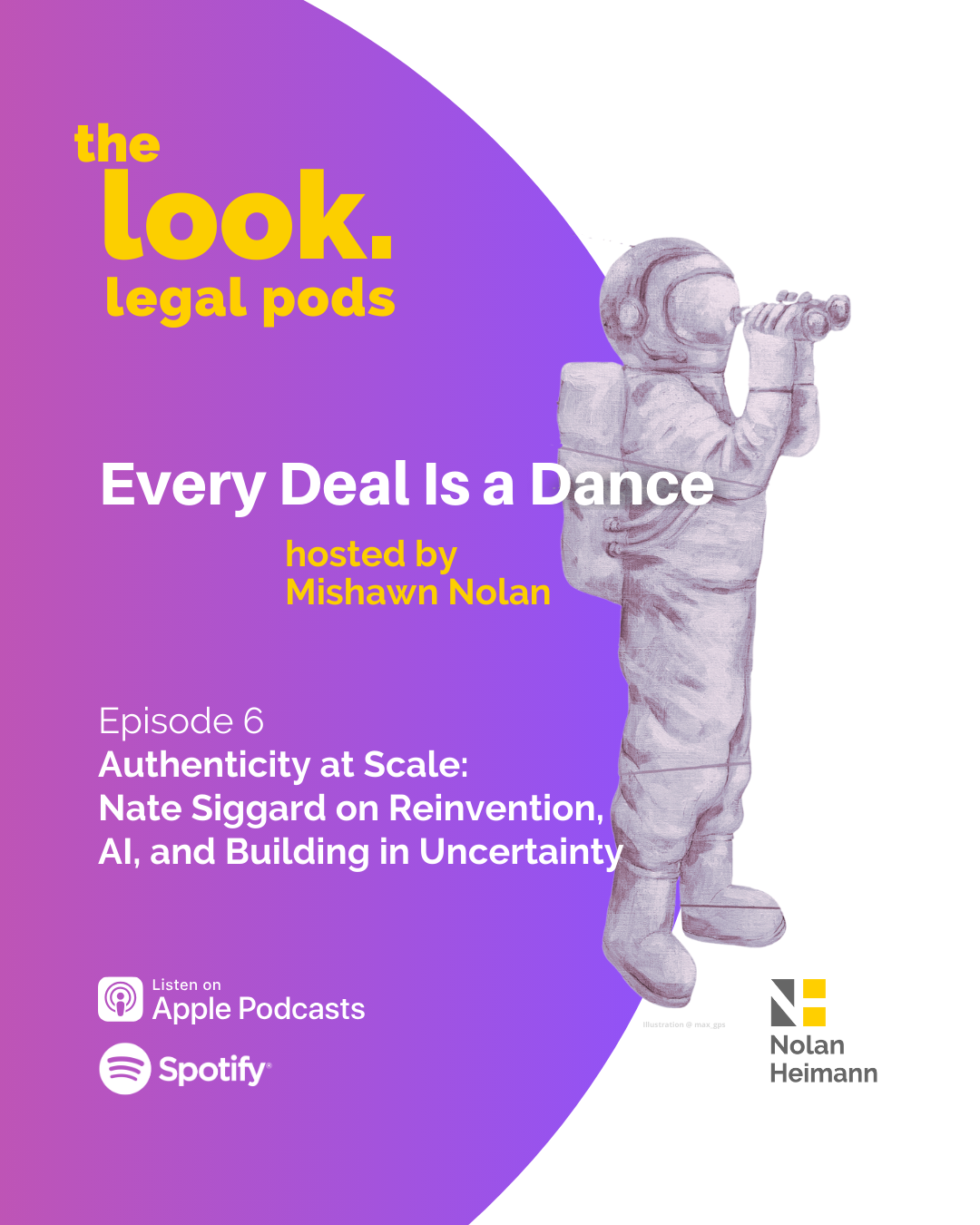


Every Deal Is a Dance Ep. 6:
Podcast Transcript:
Announcer: You're listening to Every Deal Is a Dance, part of the Look Legal pods from the law firm Nolan Heimann. And now, here is your host, Attorney Mishawn Nolan.
Mishawn Nolan: I'm Mishawn Nolan and I'm co-founder and co-managing partner of Nolan Heimann LLP. Before I was a lawyer, I was a dancer and then I was a choreographer. And so, it's not surprising that my law practice reflects dance principles of alignment and flow, especially when I'm working with my clients to monetize their creative ventures. And essentially what it means is aligning your abilities with your goals while at the same time balancing structure and reinvention. I want to make growing businesses less scary and less overwhelming for creators. So, everyone I interview in this series is someone who has a story to tell about authenticity, about their reinvention and their journey as a creative business maker. It is an opportunity to hear stories of alignment and flow in action.
I got a call from a very young and overwhelmed artist that created this mind-blowing concept that went viral online. The concept goes like this. You select a sound that has meaning to you, a child's voice, a song, a dog bark, whatever. You convert that sound into a wave, get that sound wave tattooed onto your body. And whenever you wave your phone over the wave, the sound plays. It was shocking. The artist made a video demonstrating how it worked, and the world went crazy. Everyone started hounding him and either wanted a piece of him or tried to prove that he was a fraud. It was very disturbing. He wasn't sure what to do.
A lawyer I know asked me, just talk to him. And Nate Siggard and I have been working together ever since. Once we rolled up our sleeves and started building his company, Skin Motion, it quickly became apparent that not only was Nate an artist, but he could code software, understands user experiences, could lead a team and understands business. He's a quadruple threat and he was young and visionary on top of it. I was blown away. Since then, Nate sold Skin Motion and started many other business ventures and also routinely advises other entrepreneurs on their businesses through his company, Authentic Creative. His work centers mostly on technology and design, including the nonprofit Murph’s Life Foundation that empowers and uplifts communities. and Embers Protection Services that has solutions for wildfire risk.
He's also experienced in motion graphics for television and mobile applications, and he could build you an app while he paints a mural. And Nate has been and continues to be at the forefront of artificial intelligence. Not the gimmicky part of creating funny images or asking it to write letters in hip hop style. I'm talking about the mind-bending future forecasting of the possibilities and how companies should be preparing for the tsunami. One of the things we talk about in this podcast is navigating change, and Nate's journey is exemplary of riding waves during a storm. And so, I'm excited to speak with him today about all of it. Nate, welcome to Every Deal Is a Dance podcast.
Nate Siggard: What an intro. My God. Thank you. I'm thrilled to be here.
Mishawn Nolan: So, the name of your current company is Authentic Creative. I'd say that's quite appropriate for you, when did you discover you were a creative and how did you nurture that?
Nate Siggard: I started more as a destructive. I liked to take things apart as a kid. I would take pretty much everything that I found apart, including forever asking the question “why” of any adult who would tolerate me. So, I would say that really creating began with taking things apart and trying to understand...you know, why they work and what's going on. And that started really young. I also was really into Michael Jackson and I wanted to be a singer.
Mishawn Nolan: As were we all.
Nate Siggard: Yeah. You know, not just the music, but the universe and the stories, the videos, you know, how he could create not just a feeling…it was like a prolonged experience that people could have. So, I was really into music. And in my early teens, I started playing music. And as a result of starting a band, I needed a website for my band. It was kind of when websites were coming out in like ‘96, ‘97. And so I started learning how to build websites for my band and ended up writing software. I found like one or two friends in school who were into writing code and trying to figure out how to make websites. And so, we would all kind of encourage each other. And the band playing music was a big thing in high school. I put on probably two or three hundred different concerts over those years and recorded a couple albums, and we were going to get signed and everything, but we were young and foolish, so, you know, really into all kinds of creativity back then.
I ended up dropping out of high school to, I mean, I guess I did independent studies separately from high school, but it took a lot of objection to kind of the way that everybody wanted me to go. And I did homeschool and was able to work full time and started, I was working for Countrywide, you know, when I was 14. And then I was working for a private high school in the area out here, very expensive one as a senior in high school. And so, it's kind of always gone back and forth, I guess, between always chasing like how to do a new type of craft and how to apply it to like some business case that somebody, needs done. And for the most part, like I was just blessed with the ability to be really curious, just figure out like how things work and, want to keep exploring as far as I can that way.
Mishawn Nolan: So completely self-taught, self-driven.
Nate Siggard: Self-driven for sure. There was not often a mentor who could tolerate how incessant my, ambition was, right? Like there were a lot of times I could find good mentors, infrequently would they, you know, want to talk for very long or within a week or two of falling into a subject, I would reach the point of asking questions that they hadn't considered maybe and that was frustrating. So yeah, I guess in a lot of ways, there haven't been guides. And I make a point of spending a good deal of time trying to guide other people because I knew how much that would have helped me back then.
Mishawn Nolan: So, a lot of people in your position would have thought, I'm not trained, not an MBA, I'm a destructive creator, I'm a musician, I'm not good in business, I don't know what I'm doing. But I know, and you knew from the moment I met you, that insatiable curiosity and creativity is actually a superpower in business, right? Ans so what I want to understand is when I met you, you were just coming off being a tattoo artist and you've been a serial entrepreneur and now you advise companies on artificial intelligence. So how did you go from being a tattoo artist to an AI entrepreneur?
Nate Siggard: Well, I was in tech before I was a tattoo artist. I worked with a really, really visionary, insurance executive, very young, sales focused, and insurance executive named Brent in my late teens, and we built a suite of corporate insurance products and services that he was able to package and sell to an H &R Block subsidiary. And that happened when I was 19. And I wrote all the software for that. And so, it was really exciting when a bunch of software that I wrote, in these crazies, that he had a whole office completely filled with whiteboards and he would just whiteboard top, know, floor to ceiling, the whole way around the room until three o'clock in the morning, just every day. And I would just sit there and turn his like wild whiteboard sessions into brochures and websites and apps and all kinds of stuff.
And anyway, they sold that company. And when they sold that company, I was able to work from home for a year and I moved to Mammoth Mountain. I was like, I was able to exercise a lot and get healthy and spend a lot of time learning what I was really interested in and kind of getting more into art, finding art as more of a business person. And I came back to LA and ended up getting a job for a company called Userplane. I was a front-end engineer. So, I was writing all the code for the front end for a lot of interactive apps. One of the first video chat apps you could just put on your website…really cool.
This was right before the 2008 financial crash. And I could kind of see that coming, but I didn't understand it. At the time, I was only 20, or maybe I was 21. And I could just sense that so much of what we were doing was all for show. We would have these meetings for three hours about which color orange was the right color orange, which is a great discussion to have as a designer to really get into the emotions of color and how impactful it is to get people to take actions and stuff. I don't want to discount that that is meaningful. And also, there's hungry people on the street. We're talking about orange for three hours.
You know, there was just like a like a something that didn't add up. I couldn't reconcile it. And in the process of that, kind of seeing the way that everything was going with the tech industry at the time, I thought, if I can learn how to tattoo, that's the skill that will open doors. And I think it was always about opening doors. Right. All of these various like skills along the way have kind of always just been about like, how can I open a door to a deeper conversation? And usually that conversation turns into like, how can I help you?
In whatever way that might be, even if it's a way that I've not done something before, I'll certainly figure it out and I'll care a lot more than I think most people probably would about it too. But I basically quit tech. like, you know, decided I'm not going to do tech anymore. Like, I don't believe in this. I'm getting out. And in the process, I started tattooing.
Tattooing led into a bunch of Native American heritage rediscovery and medicine work and healing, and a decade of being very enmeshed in the West Coast reggae music scene, working with all of these bands who were my idols growing up and finally going on tour around the country with them and stuff like that.
And so, it wasn't just that I was like a tattoo artist, I guess, in the sense that I stayed in my little town and just did my thing at the shop, but I was on a journey. And that journey was far, much more far reaching, I think, than what maybe people have in mind for what a tattoo artist is or whatever. So, when I came up with the Soundwave and that went viral, it was natural for me. But I've gone through all these different seasons of life. And I have friends from various seasons who maybe don't know about the other ones.
And so, to them, to see all of these things come together was like, my God, was this tattoo artist who knows anything about business, knows anything about building apps, knows anything about companies or anything. To be fair, there were a lot of specifics I did not understand or know at all that had I not been able to talk to you, Mishawn, like within that first day my phone literally would not stop ringing. And instead, the only person I wanted to talk to is you because you're the only person who had any answers really for my questions were at the time. So that was crucial. And now that's stuff that I know that I can help other people with too.
Mishawn Nolan: So, you did skin motion for several years, and that brought you sort of back more into tech. How did you leverage that into becoming an expert at artificial intelligence and being able to advise companies on what to do and how to envision the future of their business with it?
Nate Siggard: Okay. So, I will back up all of this. If I know anything about AI at all, it all comes down to that - I just use it. I'm not a classically trained nor an academic world focused researcher or, machine learning expert, or mathematician, or anything like that whatsoever. I just want to preface that now. On the other hand, my extreme curiosity combined with the decade of self-discovery and Native American medicine work, has allowed me to have a unique perspective on consciousness and technology that I, I'm able to apply while, just being curious and asking questions in a way that has allowed me to leverage, the unique capabilities of AI in a way that I think is, not automatically obvious to most people until you sit down and try it. I think for most people, as soon as they sit down and can watch someone else work with this alien technology kind of, and see, wow, like I could use it in that way. That makes perfect sense to me now that I've seen it. it's, there's like the folklore, you know, the Native Americans couldn't see the ships that first came from Europe because they had no concept of what a ship was, in that way.
I think with AI, it's kind of the same for a lot of people. It's like meeting a new person and having this conversation and being like, all right, well, who are you and what are you about and who am I in relation to you? And I think those are questions that like people kind of have like default mode networks already sort of, hi, nice to meet you. I'm this person. And, you know, it doesn't get a lot deeper than that often because it's just useful in society, whatever, getting along with people. In any case, the AI just made sense to me, I guess. At least large language models and certainly floating point, this idea of a grid of objects that are all in perfect relation to each other mathematically, I think. Or there's Hindu concepts that are similar, right? Like Indra's net, which is the concept where like every individual drop of water contains the reflection and content of every other drop in the network. And in a way, AI is kind of the same, right? Like every different concept that we could think of, every word, even broken down into every letter has a particular mathematical relationship to every other word and every other concept. And those can be mapped. And the maps can be applied for all kinds of different benefits, right? And I think we're learning what those are.
So anyway, and I think the main thing right now is to figure out do we want as an outcome? And I think for a lot of businesses, right now it's fear. One of the best properties of AI is that it's like a magnificent mirror. And when I say AI, I'm talking about large language models. But they act as a perfect mirror of the collective. And whatever you bring to this thing, it's going to give back to you. so, you know, for businesses, if you're thinking, oh my God, this is going to destroy our business or we're going to have all these competitors and now, we don't know how to plan for a future, which is uncertain. And so, they bring that energy to their AI and it reflects it back to them, basically, you know, and I think we're seeing that now also with like AI psychosis. There's a lot of side effects of just providing these tools to people without any kind of cognitive inner landscape from which to be able to navigate them properly. I don't know. It's so new and emergent that even these types of conversations getting into the weeds of even thinking about it are hard because the language, I don't think, fully represents the concepts yet.
Mishawn Nolan: Right. For purposes of this conversation, my question for you, though, is why AI? Why diving into AI? Why is that authentic to you and your creative drive?
Nate Siggard: Well, okay, as a mirror, as a cultural mirror, have two things, guess, two ways to look at it. One is looking at the past and one is looking at the future. And I can apply the AI to evaluating data and the...the relationships that exist between information and different types of data in ways and at speeds that I was never able to do before with a simple prompt. don't need to sit here and wrestle with deep math algorithms to try to compare data. I can just throw an entire spreadsheet into a large language model and start asking it questions help me come up with a formula. Anyway, it's not good at math. So, you have to ask it for a formula. It'll give you a formula and you can apply the formula in a spreadsheet. But there are little things like that, right? Like I think that are important to figure out where if somebody does try to ask it to do math and it doesn't do the math correctly, they're going to say, this thing doesn't work right. And it's like, well, if you ask it for the math formula and you put the formula in a spreadsheet, then the spreadsheet will actually do the math because that's what the spreadsheets for.
I think most things with AI for most people are like that, where there is a tiny shift that can happen in the thinking of how can I apply this and in what way is it going to give me a positive sum outcome that often just looks like asking in a slightly different way. And I think it's the same for people, frankly. The better that people are able to work with AIs, they will be better to work with other people.
There are people who treat AIs really mean. And similarly, I think there are lot of people in business who are not exactly the nicest people. And I think AI is going to expose that to us a lot faster. We’re going to get whatever we put out magnified back to ourselves instantaneously. And what do as a creative individual, as a sentient person with free will who is able to leave a mark on the world around you, how do you use that? Right? AI is only going to amplify whatever it is that we show up with and want to put out.
If we show up with fear, if we show up with distrust. Honestly, I think the biggest threat that AI poses to most people is that privacy and secrecy is essentially over. Right. And that can be incredibly terrifying if you're not living authentically and you're not in a true, you're not speaking your truth, you're not asking for your needs, you're not holding your boundaries, that's a very terrifying thing to not have a safe, private, secure place away from other people.
And we are at the point now where technology will begin to cross over into the privacy of our own minds. And in many ways with algorithms, we're already past that. The algorithms are already having an effect on our neurocognitive conscious landscape. And if we're not taking ownership and responsibility over that, then someone else is going to take ownership and responsibility over that for us. And I think it's absolutely crucial that everybody takes the time to learn what tools are available and how they can personally take responsibility and use these things for their own betterment and not be taken over by somebody else's interest.
Mishawn Nolan: Yeah. And, and so whenever, whenever you operate a business, right, when you grow a business, you know this, you have to start from your values. What are your values? Because the stakeholder values are going to drive the direction of the company. And the more authentic you are, the more real and raw you are about what your values are the better off the business is going to be, because if you try to set out values and vision for a business that's inconsistent with who you authentically are, you're going to have just constant friction. So, as you said, AI is going to reveal all of that. But going back to using those type of value driven and authentic driven tools for operating a business, have there been times where your authentic self, your authentic values were in conflict with business pressures with business realities? And how do you deal with that?
Nate Siggard: Yeah, I like that's the entire, I would say if I had to define being the CEO owner of a startup, then that is the definition of you have to hold so many different simultaneous realities that are in paradox with each other without trying to have to resolve them. They have to be allowed to exist in parallel like Schrödinger's cat. Like you don't know if whatever is behind that cabinet is alive or dead. And frankly, at this point, it's not your job to go looking. Your job is to take the next step that's in front of you. Don't go knowing that the cabinet is there is still so stressful for most people. I think of it this way these days, it’s really important to have a really strong CEO who can have a vision and who can set the goal and inspire everybody and keep everybody aligned towards a similar outcome. And also, to have a really good COO who's deep in the weeds of all of the problems. Because as the CEO, if you're wearing all of these hats at once, then you're splitting your own self into all these constituent selves and each of them has to show up in a matter of switching personalities in five-minute windows, right? Where you're on a meeting with your support team and everything is a problem. The whole thing is on fire. Everything's melting down. And then you have to jump on an investor call in five minutes and talk about how amazing everything is and how it's going to be worth so much money in the future. And we're all so excited about everything that's happening. And that change from that first call to the next call in five minutes is devastating on your inner, at least it was for me anyway, on my inner experience. I felt like, I'm a fraud or certainly the imposter syndrome constantly. Because everyone else is telling you how successful they see you as. And on the inside, you're going, oh my God, there's a million things that I need to do right now that I cannot possibly do because I don't have enough time or money or friends or people to help me, whatever.
Mishawn Nolan: But that's every entrepreneur. I mean, I'm an entrepreneur and I work with entrepreneurs every day. I speak to many entrepreneurs every day and that is the life.
Nate Siggard: Yeah. It is overwhelming. It's certainly, there must be something specific about particular people who seek it out. Because the second that I had alleviated myself of that stress, I immediately dove into trying to find it again. And, I think frankly, this time around, it kind of found me. I've always been very passionate about the fires, back in 2017, actually, me and my brother were able to save my in-laws house from the Woosley fire. It actually caught on fire and through our pro action, we were able to get a fire department up there and put it out. But as a result, particularly the Woosley fire and a friend I have out here, actually really amazing mentor who tracks fires and actually is super involved in the wildfire events when they happen.
Emergency management, you know, kind of train me to how to listen to the radios and pay attention to the fire. So, when the fires happened in LA earlier this year, it was really impactful. I had multiple friends' houses burned down. I live against the wild spaces. So, you know, I've got a big garden and everything, but it was very scary from the perspective of this, could impact me at any point. I got really deep into the technology of what we were doing with fires and what we could be doing with fires. I think it's a really common thing that people say, like, we should just put sprinklers on all of our houses and then we would be safe. And I think we kind of brush that off and laugh at, at least I did earlier on in January when all this stuff was going on. It's kind of like, yeah, sure, that'd be great. I went to an even further extreme where I just wanted to build my house out of dirt because dirt doesn't burn.
I did a whole lot of research on that, went really far into like, how can we change public policy to be able to have permitted houses built out of things like straw, bale, and rammed earth, which are basically only possible if you have obscene amounts of money in order to do very bespoke, legal regulatory work, getting permits and stuff. And then I had this amazing opportunity, I met Chris over at Embers Protection who actually had saved a few houses in the Palisades fire one of the Embers Protection systems. And actually, it wasn't just the house that had the sprinklers on it, it was also the houses next door who benefited from the house that had the sprinklers on it. And, at that point, basically I realized this is something that of the circumstances, this is something I can get behind. I think...believe in wholeheartedly no matter what. And at a time when I think it's very hard to find things to believe in wholeheartedly no matter what.
But keeping people safe and figuring out ways to use technology to basically deal with uncertainty. We're trying to prepare for a future that we can't predict. We know that there will be fires because they are a native part of this land, but we can't predict when and we certainly can't predict how they're going to affect us, and so we can try and mitigate that risk as best we can on an individual level. And I guess that's kind of where we're starting right now. But my thinking has sort of turned to think about scale in the way that AI has really taught me to think about things in scale where, this last fire looks like is probably going to be California's fault. And they're the ones who are going to get stuck with the hundred-billion-dollar liability.
And so, you could look at maybe spending $1 billion to put sprinklers around the most at risk areas of the city as a 1 % investment with a hundred times return rate if we have a $100 billion fire every 10 years. Which makes it the most obvious investment we could possibly make.
Mishawn Nolan: Well, my area, so I almost lost my home during the Woosley fire. And I live in an area where I'm up against, I'm surrounded by hills. You contacted me earlier this year, you were making sure that I was okay. And we were okay. And we evacuated once or twice. But what my area does is they hire goats. And the goats eat a ring around the area. And I always thought, you know, every spring we see the goats, wave at the goats, it's all cute and everything, but I didn't really get it until the Woosley fire. And what we learned was because the neighborhood community had the goats eat a ring around the community, it saved my entire area. Just having the goats. And I mean, it's those little things, right, that the community gets together and the neighbors, what happens to your neighbor impacts you, right? And what you do impacts your neighbor. And just having those goats saved my entire community.
Nate Siggard: Yeah. Well, and that would have been like a normal kind of goat herding is a normal cultural thing everywhere that goats exist. And if they're not goats in other cultures, there are other similar herbivorous, creatures that they live symbiotically with the land. think we've separated ourselves from the land so much that something like fire seems like this, seems like technology in the sense. And frankly, it was the first technology. Right. Fire was the very first technology, you know, it feels separate from us.
In a way, I think a lot of my artistic work these days revolves around the reconciliation of everything being connected in ways that we can't possibly fathom, but that are evident the more deeply you look at them. And in that way then, how can we live with fire rather than, other it, keep it as this thing we have to fight and beat.
And instead, we can use prescriptive fire. It gets foggy, we could just have prescriptive burns and there would be nothing left. Same with the goats. And a lot of these things are political will. I think a lot of these things are personal responsibility. There's a lot of layers to it. But in any sense, I’m very interested in what types of actions can we take that are going to scale society-wide change.
Mishawn Nolan: Right, so the very fact that you are now leaning in, becoming this expert on fire prevention, preventative measures for fire, demonstrates another reinvention. You are someone who constantly reinvents yourself. Actually, I like reinvention more than you like stability. I think stability would stress you out more than change. Reinvention is scary to a lot of people, right? It requires you to be constantly nimble and changing. How do you deal with the fear of the unknown, of constantly reinventing yourself?
Nate Siggard: Well, I would. I guess I can't, I don't have much of like a diplomatic answer, but what comes to mind when you say that is as a kid, I was always extremely risk averse. And in my risk aversion, I was constantly over analyzing everything happening around me as well as everything happening inside of me to a degree that I think would probably tire most people very quickly. So, I developed a very high capacity for that sort of constant evaluation of everything, which was, would say, debilitating until about the middle of my 20s when I got very deeply involved in Native American plant medicine work. And as a result of that, was able to find a level of understanding with myself and with my creator in Great Mystery and sort of find a peace in the not knowing, yet looking back, seeing that every next step was always provided for in a way I couldn't see at the time. Every challenge that came up, everything that was sort the end of the world, my worldview or whatever, at whatever period of time, something out of my control, in every single case, as soon as I let go or relinquish my desire to control the outcome of that situation, something new showed up that was more aligned and was leading me further along my path, whether I knew it or not at the time.
I kind of think of that like this scene in Indiana Jones where he's got to walk across the little canyon on the glass walkway. And I use that analogy, the glass walkway of faith, as an analogy to talk about, you know, kind of, we don't know what the future is going to have in it. And oftentimes, I think, you know, similarly to that glass walkway of faith, it can feel like falling, I do not want to be in this limbo between places. And I think a lot of people spend a lot of time trying to avoid that feeling of limbo, the liminal space, which is frankly, one of my favorite things about AI. It will go so deeply into all of these little liminal spaces. But I used to fear the liminal space in between things where there wasn't clarity, where things were not black and white, where form broke down into energy, let's say even. And was able to realize, there is no floor. I may be falling, but there is no floor to hit. And so, if there's no floor to eventually run into, then I'm not actually falling, I’m flying. And I think in every moment of uncertainty or of fear about the future, of not knowing what may come next, there is that sort of, trust and faith and acceptance of what's happening that, for me at least, has always wound up in opening whatever door is the next step. And the more I look back and I see that happen again and again, the more I can trust in the future it's going to keep happening. And I think it's also a result of, putting out into the world what it is you hope to get back. Certainly, that looks like a lot of service and thinking about ways to help other people and asking other people which ways they would like to be helped. But, you know, in every case, and especially for business, I think spending a lot of time thinking about what the other party is thinking or what they might want or asking them directly. mean, think assuming good intent, assuming the best out of other people, not jumping to conclusions or thinking that people are against you. Generally, when you think good thoughts and you hope other people are doing the same, it works out great. And it's clear very quickly who is not aligned with that.
Mishawn Nolan: Right. mean, when people come to me with like a new deal, we talk about, you know, why they want to do this deal and what does it mean for their business and what do they want. And a lot of clients, they want me to put together a proposal. And my response is, I can't begin to put together a proposal because I have no idea what the other party wants, who they are, what their fears are, what they're looking to accomplish. And so, the first step for me in the process is always - let's interview them. Once we've interviewed them, I mean, I've already interviewed you. I know you. I know what you want. But we have to know them. And you have to know them. And then that's where you align. So, I agree with you completely. But we've been doing this together for a long time.
Nate Siggard: To add to that though, it is very hard to find other, especially people who are focused on risk and law, who can still think creatively and want to step into the shoes all of the parties in any kind of agreement and to understand how everyone can win because there is always a way where everyone can win if everybody is playing with good intent.
Right? If we're all playing this game, know, whatever capitalism or, you know, life, whichever game we're currently playing, if we're playing in a way that we believe that everyone can win, then everyone can win. It's possible. And I think a lot of times we get stuck in very black and white thinking of there has to be a winner and a loser. And that is very zero sum. But I don't think that.
Mishawn Nolan: Correct. That's exactly why this podcast is called Every Deal Is a Dance, because most people go into deal negotiations as if it's a battle. I win, you lose, or you win and I lose. But actually, you go into a contract negotiation to find a dance partner so you can move to the same beat. You guys can complement each other and help create something greater than you would have on your own.
Nate Siggard: It also helps a lot to have people on the outside who can see things objectively. I mean, being in the middle, being a party to any type of agreement on that level where there are lawyers involved on both sides, sometimes even multiple lawyers who represent you and your company against you at the same time on the same call. And you're watching $2,500 roll around the clock every hour because of these very long discussions with very many interested parties. It can be easy, you know, as the founder person in those shoes to just think, my God, what is happening? Like all of these people are against me. How did I get myself in this situation? Maybe you want to your head in a hole and not think about it, you know, whatever it may be. And so having somebody who's on the outside, who you trust, who can be objective and just say, hey, this is what needs to happen right now. And it will, it will be okay. We're going to find a way through. Everything's going to work out. That's helpful, right? I I certainly think that's one of the things I hope to do the most for other founders and CEOs and things at this point is just a lot of reassurance. You like you're going in the right way; make it work out. It's easy to forget. It's very easy to forget in that moment as one of the people in the situation that we all at the end of the day, we all just want to live our life and be happy. And everybody's trying to look out for whatever they think their best interest is. For me, learning how my best interest is, I can find my best interest through respecting and holding other people's best interest at heart. Right.
Mishawn Nolan: Yeah, yes. Entrepreneurship is really lonely and it's really scary. So, what is a myth about being a creative entrepreneur that you wish that you could tell everyone listening, don't listen to this myth, this is the reality.
Nate Siggard: I mean, think the greatest myth is this idea that anyone is like really an authority or an expert or like imposter syndrome is this like self-applied myth that there are other people on some hierarchical level who somehow rank or classify or relative to you are somehow better or something. And everyone feels that imposter syndrome feeling – it’s a meta-analysis like, my God, I'm recognizing that I'm recognizing myself, collapse of consciousness and awareness that I think is overwhelming no matter who you are. I think the people I've spent time with who I've put on pedestals and who I would think are very successful and have ascended any kind of status or whatever that I would hope to attain, they all struggle from exactly the same day to day lifestyle experiences and issues that we all do. It's very human. I think the more I can see other people's humanity, the more I realize the myth of, you know, that we're somehow separate and different at any, great level is mostly imagined. And I'm always trying to break down that barrier as much as I can.
Mishawn Nolan: At the end of the day, we're all humans. And the more human and real and raw we are with each other and try to work together, the better off our businesses are.
Nate Siggard: I think if you're the CEO of a company and your staff won't tell you the truth, your company is doomed. If you aren't willing to listen to other people and thank them and value their open and candid input, even if their open and candid input is you're not, I don't think you're doing things the right way, the business then is functionally a game of playing pretend. And instead of playing the game of how do we provide this good or service at the best margin in order for the benefit of everybody involved in the process from the customer all the way to the employee - instead, we're playing a game of pretend. And the game of pretend is I'm pretending to be aligned with this, as the employee, whatever, I'm pretending to be aligned with the CEO, even though I can't actually tell them that I don't agree with all of these things. And actually, this particular choice or behavior is actually harmful. And if that is allowed to continue without openness within a company, then the company is already suffering from something far greater than any cost basis or deeper level business quote unquote issues that I think a lot of consultants or CEOs, people who...you know, go the MBA route and are very like trained business people are going to look for metrics in order to point at the metric and say, well, over here, we've got an issue over here, we've got an issue, whatever. But frankly, for me, everything comes down to can everybody be honest? And do you feel safe? You know, like is it is this a safe place where you're allowed to be honest and tell the truth? And that is like the most core fundamental thing to having a successful business at all being a team, making sure that everybody's going in the same direction. But I think, there are dynamics between business owners and the staff at various businesses that constantly have to be evaluated to make sure that everybody's aligned and, keeping secrets from the boss is generally one of the more destructive and challenging issues to deal with both, you know, as a prior business owner, as a service provider now running like an agency and also as like a middle manager at various different places, I have to wrestle with these dynamics from all of the various perspectives, which is actually very helpful because then I can see where all the different parties are coming from.
It's very hard when you're the creative founder who is thrust into business and all of sudden, you're hiring your friends and a lot of times or people you know or family even, and they are certainly not going to tell you, hey, this customer is very angry or, thing over here went totally wrong, needs to be fixed. Like, and if too many of those pile up, that can be a big problem.
Mishawn Nolan: Yes, honesty and safety is critical. Well, thank you very much, Nate. I really appreciate your time and your very unique perspective on everything. And thank you.
Nate Siggard: Yeah, thanks for having me.
Announcer: Thanks for listening to Every Deal Is a Dance. If you've enjoyed the show, please share with other creative business makers and kindly rate and review us on your favorite podcast platform. For more information on how we can help with your own legal needs, check out our services at nolanheimann.com. That's N-O-L-A-N-H-E-I-M-A-N-N.com.