
The Licensing Exchange Ep. 6: From Pokémon to Manga's Future: Jazwares President Jeremy Padawer on Collecting and the Toy Industry


Jeremy Padawer has spent over 25 years in the toy industry, from his start at Mattel to founding Wicked Cool Toys to now serving as President of Jazwares under the Berkshire Hathaway umbrella. His journey includes acquiring Squishmallows, building global licensing programs for properties from Pokémon to Roblox, and navigating the sale to private equity before the Berkshire Hathaway acquisition.
But Jeremy is equally known as an avid collector whose public bets on emerging categories have proven remarkably prescient. In 2019, he publicly committed to spending a million dollars on Pokémon collectibles, documenting the journey to educate other collectors. He facilitated Logan Paul's legendary $6 million purchase of the PSA 10 Pikachu Illustrator card (which recently sold for $16.5 million). And he just announced a $275,000 world record acquisition: the highest-graded Volume 1 copies of One Piece, Naruto, and Dragon Ball manga.
In this conversation with hosts David Schnider and Greg Pan, Jeremy reveals the undercapitalized startup strategy that built Wicked Cool Toys (A-level brands, B and C-level categories), why he had to beg retailers to take just two Cocomelon items before doing $100 million in year one, the inside story of the Logan Paul Pikachu card deal and flying to Dubai for the transaction, his conviction that manga properties like One Piece (which surpassed Superman in sales in one-third the time) will become the Superman and Batman of the next generation, why kidults have displaced 6-11 year-olds as the number one toy segment, the strategies for convincing risk-averse retailers to take chances on social media-driven properties, why tent pole properties in 20 years will be anime films, his prediction that graded manga represents an undervalued alternative asset class, and why participating in trends beats reading trend reports.
From the woman at Comic-Con who faked a knee injury to get a limited-edition He-Man statue, to his role in "the brutal destruction of He-Man for 20 years" as a young Mattel brand manager who didn't speak up, to his philosophy that following your passions makes you better at your career, Jeremy offers essential insights for anyone in licensing, toys, collectibles, or building entrepreneurial ventures in competitive industries.
The Licensing Exchange Ep. 6:
Podcast Transcript:
Announcer: You're listening to the Licensing Exchange, part of the Look Legal pods from the law firm Nolan Heimann lawyers for creative business makers. And now, here are your hosts, attorneys David Schnider and Greg Pan.
Greg Pan: Welcome everyone. Our valued guest today is Mr. Jeremy Padawer. He has been in the toy industry for a very, very long time. He has worked at Mattel, Jakks Pacific his own toy company, Wicked Cool Toys. I did some deals with back in the day and has been in Jazwares for quite a while. He is the newly minted president of Jazwares. So will be interesting to hear what direction and future he has with the company and what he wants to do.
Jeremy, thank you for being our guest today. Great to see you. You're always moving. You're also an avid collector, so we'll get into a little bit of that and how that crosses over into toys and licensing.
Jeremy Padawer: I'm glad to be here with you guys. This is exciting. Thank you for having me.
David Schnider: Yeah, we're looking forward to talking to you. So, I always like to start with the same first question, which is, how did you get into licensing?
Jeremy Padawer: Well, I was very fortunate, when I was in, in school, I balanced my education with a job like, you know, so many people, you're paying for your own education. And my job was essentially buying and selling domain names and setting up websites and gaming Yahoo. Yahoo was nothing more than a search engine with the worst, possible filter ever. They would let you on and sort you A to Z. So, if you named your website with two A's, you go first. I did a lot of toy and collectible websites and like absolute Beanie Babies, absolute Furby, absolute this, absolute that. I showed up first in search on all of these toy categories and then started buying domain names because I believed that they would have direct navigation traffic, which would carry more eyeballs to the content that I made. I was right. That worked. And after I graduated, Mattel found my background somewhat interesting. So, in 2000, a little over 25 years ago, I started in the toy universe. And that's what led me down the track of licensing.
Greg Pan: Well, that toy arbitrage mindset has been with you for a long time.
Jeremy Padawer: The collector mindset is an arbitrage mindset. I would say the collector's brain is transactional. It's also a fandom brain, but it also understands the value of a dollar. And so, the mix of being a collector and now, having had one of the bigger manufacturing footprints over the last 25 years, through working at big companies and starting my own, ultimately ending up under the Berkshire Hathaway umbrella, I've had a lot of good fortune to get a lot of insight. So, I do feel like I have quite a bit of knowledge in terms of the toys and the collectible space and really decent vision when it comes to what may be the next things to play with, collect, and for both fun and for value.
David Schnider: So how did you go right out of college? I think you were at Mattel and then to Jax if I recall correctly, but then how did you go to starting your own company?
Jeremy Padawer: Well, yeah. So, I, at the point in time, which I started a company, had about 13 years of toy experience. I did a JDMBA prior to that. I had finished up at Vanderbilt and I, and I had run a business of my own, an entrepreneurial business. So, like, by the way, none of that's necessary to start a company. All you really need to start a company is have a little bit of gumption, be resilient, be willing to lose and have a good idea. The key in success in starting a company is resilience, a good vision, good positioning, and not just acting idealistically, having a plan that sort of matches the reality of your situation. So, when we started the toy company in 2012, it was called Wicked Cool Toys originally. And we were undercapitalized.
But we were also going after categories and items that were available. So, we started the business on novelty items for Teenage Mutant Ninja Turtles. We literally were selling balls that bounced with little mini figures inside and, and other things that were sort of at the lowest level of the licensing totem pole. And keep in mind, this was after having been at the, you know, highest levels of Jakks Pacific, I was the COO of their animation partnership and I was the EVP of all brand marketing. And so, I had a lot of experience leading the vision there. So, the combination of having the background and being sort of willing to be the little guy again is what made us be able to start a toy company in 2012.
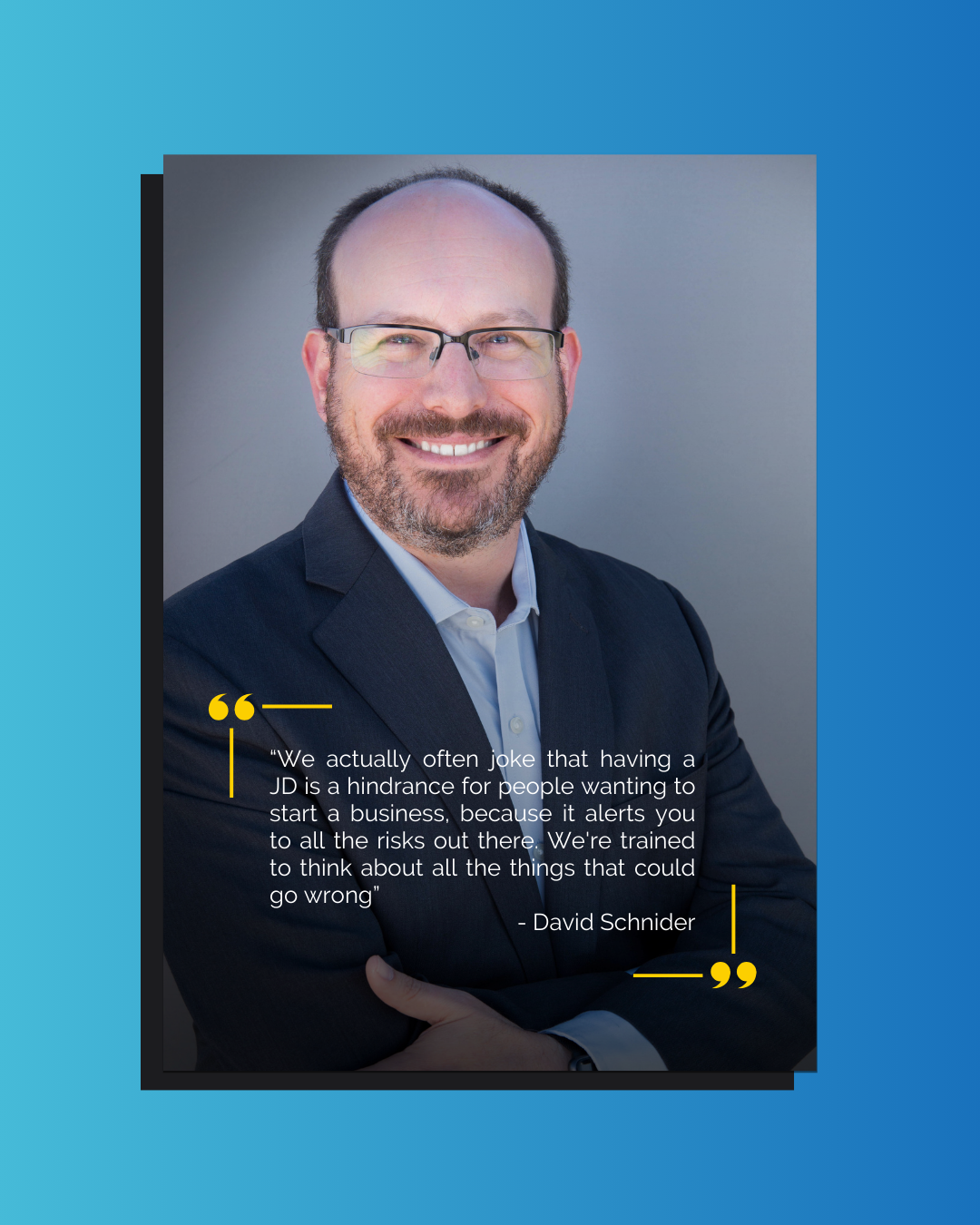
David Schnider: We actually often joke that having a JD is a hindrance for people wanting to start a business, because it alerts you to all the risks out there. We're trained to think about all the things that could go wrong.
Jeremy Padawer: Well, I'll tell you this, you're exactly right. That's the, for me, I spent several years in law school learning how people do things that are questionable and how risky the world is. And then I spent several years in business school learning about how much opportunity there is in this world. And so, I really feel like I kind of balanced out the risk threat and the risk assessment with the reality that there are opportunities and there's always going to be opportunities depending on what your expertise is in the field of play that's being offered to you. So yes, 100 % agree with you.
But also, I've also found that people with JDs are extraordinary operators because they're willing to do the difficult operational finance, accounting, the stuff that I personally find abhorrent, they're willing to get into the weeds and they have that mindset to do so. And that makes for a very effective leader in an organization.
David Schnider: It's funny you say that I'm one of the co-managing partners at our firm and that is exactly what I do. And it's that legal background that helps me do it.
Jeremy Padawer: Listen, I'll bet you everybody when you walk in, they all have a big sigh of relief because, you know, it's one thing to be an operator who can get in the weeds. It's another thing to be willing to do it as you go forward in your career. It just sounds like, it sounds like you're someone who never let your toolkit get dull. You know, you keep a sharp toolkit over there. So that's good.
David Schnider: I'm a freak. Love it. So, I'm curious when you weren't exactly starting as a small company, but we get asked by people all the time about how to get into the licensing industry and about the challenges of getting the first license and figuring out where to start. Did you have to deal with that at Wicked Cool? And if so, how did you deal with it?
Jeremy Padawer: Yeah, we, we look, the good news is we had had enough experience to where we could get into any room we wanted to get into. The bad news is that getting into those rooms is just part of the battle. The other part is they have to trust that you can actually make safe,quality product, ship it on time and not screw up their relationship with the retailer. And on the flip side, the retailer has to believe the same thing, that you have the capacity of getting the types of deals that can be worthwhile for them. So, the way we played it was, look, we want a level brands, but we want B and C level categories. That's the way we started. So going after things like novelty, where generally a licensing partner doesn't have an exclusive relationship. And generally, it's sort of like an incremental item on their P and L. Um, it was massively helpful. It definitely put us in a position where we could compete.
Now, what we were used to was playing for A and B level properties at the master toy level category. And it took us many years to get to that level. In fact, we didn't get there for maybe five years. And by that time, we had really burnt through, our funds, and our patience and maybe the patience of everybody - everything really worked out in the end. And I'll take you through that beautiful story as we go through this conversation.
Greg Pan: Just curious, did you start with licensed product or did you start generic?
Jeremy Padawer: We started with licensed product. So, once you get Turtles or WWE or a couple of the other brands, we got in some of these secondary categories, you go to retail and you say, Hey, look Walmart, right now with your WWE line, you make roughly 30 % margin. and you take 12 items, but if you simply substituted your least two productive items with our items we could raise your overall margin and profitability because we're small.
We can take less and we can make your productivity faster because our 11th and 12th item will be better than anything that you've got on your shelf at 10, 11 or 12. And so you come with a logical math argument and you can make a dent. I mean, for us, it was more productivity for retail. make more money per skew and they get to dump skews that are not necessarily as viable.
Of course, it's easier said than done. And when you're working in some of the categories we were working in, just by the nature of those categories, you're not going to be at the top of the food chain in terms of your productivity. But it got us in. It got us all of our vendor numbers. It gave us an opportunity to fight. And we were formidable. Even early on, we were formidable.
Greg Pan: So, did you get the license first and then talk to retail? Because one of the issues that licensees usually have is they can't get into retail without licenses. They can't get the license without a retail in. So how did you kind of overcome that challenge?
Jeremy Padawer: Yeah, we got the licenses first and then we went to retail. And for the most part, especially in an era where Toys R was around, Toys R Us was a great, great friend to entrepreneurial companies. Without Toys R Us, sort of the way to accomplish that today would be more with Amazon, but the discovery of product is vastly different. It's just hard to get the discovery. Look, when you can put a wall walker that sort of looks like an action figure, but you splat it up against the wall and it squalls down the wall. When you can get that sitting next to an action figure, the main course of turtles, and it's within six inches of that item and you're priced at half the retail, you do have an opportunity to sell to a mom or a dad who's just trying to get their kid out of the store.
David Schnider: Yep.
Jeremy Padawer: And they're willing to spend five bucks, but they don't want to spend 10. But that's not realistic on Amazon. On Amazon, maybe you'll come across something, but the purchase intent is very different than when you're at the store and you're trying to get someone to agree to making a purchase.
Greg Pan: Where the term “shut up toy” comes from. You get the toy to shut up your kid.
Jeremy Padawer: Yeah, the shut up toy is legitimately a novelty toy, something that's, you know, historically $5 or less. Maybe nowadays that's been pushed to 10, but something to where, it doesn't change your ability to even no matter who you are, it doesn't really change your ability to, to, grab food on the way home.
David Schnider: I remember even to this day the excitement of going to the Toys R store and to this day when I get off that freeway exit, I still get a giddy feeling. I do not get that giddy feeling loading Amazon. I'm curious though, so given that shift since a lot of the toy business has moved maybe to big box or away from retail and online, how do you get products out there now?
Jeremy Padawer: I mean, look, online is a formidable part of the process, but it's still just a part.Every year e-commerce becomes a bigger part of the pie. Amazon is enormous, obviously. And Walmart's online sales and Target's online sales and third party, it's all very formidable, but it's, but, still brick-and-mortar is your number one go-to for, for sales.
David Schnider: And is that mostly like Walmart, Target or is it really more diversified than that?
Jeremy Padawer: I mean, Walmart, Target make up a large percentage of the brick-and-mortarsales. Ideally, however, you have more diversification.
David Schnider: All right, so taking a step back, how did you give up the dream of your own company and end up at Jazwares?
Jeremy Padawer: Well, I didn't. So, we sold to private equity and I retained 30 % of my shares that were converted into a share of Jazwares. So, the shares that I had were converted into Jazwares shares by Alleghany Capital. And then we immediately sort of got really aggressive and bought Squishmallows, which turned out to be one of the best decisions ever.
But like, I never gave up the dream of being entrepreneurial. I just stayed around for a second bite at the apple. And in 2022, we all sold the Berkshire Hathaway and became part of that giant umbrella. At that point in time, you could argue that I gave up my entrepreneurial hat, but I did personally take the money that I received from that sale, and I almost bought exclusively Berkshire Hathaway stock with it so that I would still feel like I had skin in the game. For me, was more of an emotional, like I still want to kind of own something. And I felt like, you know, pretty excited to have a little teeny, teeny, teeny tiny piece of Berkshire Hathaway.
Greg Pan: So, let's talk about your new role at Jazwares. Can you tell us a bit about what are your responsibilities and kind of what your goals and vision is for the company going forward?
Jeremy Padawer: Yeah, Jazwares is a company that was founded by Judd Zebersky who is a brilliant, hardworking guy who spent basically his first seven or eight years almost exclusively in Hong Kong and China learning the manufacturing side. Interestingly enough, Judd also is a lawyer. So, Judd's background in law, I think, you know, David and Greg, as we've already talked about, it gave him the ability to kind of get into the weeds and get interested in things that purely creative people might find a little less engaging. And I think that the special relationship that Judd formed with the manufacturing side was a very critical part of our development. In the meantime, Laura Zebersky who was also a lawyer, joined him, interestingly enough. And I would say they were one of the most successful husband wife teams I've ever seen. So, when I came in, my expectation was just like anybody that sells a company, I don't know how long I'm going to stick around. And, you know, I had been in the co-CEO president role for quite some time and I didn't know if I could, you know, really report to or work with anyone else. And they were great. They understood, you know, what an operator needs. And we worked wonderfully together.
So, in terms of vision, I can pretty much state it this way. I'm going to make sure that we as an organization maximize our current slate product, and then we're going to be very, very aggressively looking into new categories, both licensing and categories of play, to basically put ourselves in the best position to continue to grow and thrive.
Because the truth of the matter is, in the toy industry, you have enormous turnover every single year. And if you're not innovating and you're not looking for new things, you very quickly become less relevant in the category.
David Schnider: So, what do you see as sort of the coming trends for the next couple of years?
Jeremy Padawer: What we're doing next as a business is sort of under lock and key. But I can tell you, on a personal note, as a collector, even today, I just announced that I essentially a new world record and an acquisition of created manga. I'll step back and say in 2019, I decided to go very public with a journey of spending a million dollars on Pokémon collectibles. And I was very vocal about this. Every step of the way, I turned it into content, mostly because I believed in it so much, but secondarily, because I felt like it was a real opportunity to educate other people who loved collectibles.
I've only had that level of conviction a few times. And I'll say right now I have that level of conviction with graded manga. To give you an idea, One Piece, Dragon Ball, Naruto, these are some of the biggest brands in the world. They're roughly the equivalent of a Superman, Batman, Spider-Man. The Golden Age comic books at the highest grade, if you look at Superman 1, or sorry, Action Comics 1, at a 9.0, that book just recently sold for $15 million. So here we are in a world where One Piece just surpassed Superman as the most selling comic of all time. One Piece did that in 29 years. They beat what Superman did in 86 years. So over 600 million manga slash comic books sold in one third the time. And I announced today that I bought the highest graded volume one, One Piece, Naruto, and Dragon Ball in the world. And it was a $275,000 purchase. Compare that to - if I went out and I bought the number one Batman, Superman, action detective, and I got them in the highest grade, I might be spending 10 to 15 million dollars per book. So, I felt pretty good about this, and that's really the collecting thesis. It's global, the storytelling is incredible, their ability to extend brands over a long period of time is also remarkable. And I just really genuinely believe that to our kids and to their kids, manga and some of these key properties are Superman, Batman, Spider-Man, and even beyond that, because they're more like lifestyle brands. You see people that are dressed and enact. It's just, it's a whole, it's a whole lifestyle.
Yeah, I think if you look at people in their 20s, they're bigger manga fans, they're bigger Dragon Ball Z, One Piece fans. They don't know Batman as well. They don't know some of the side characters are. So, the trend has definitely shifted a bit
Jeremy Padawer: Definitely, and the storytelling is so, the storytelling was always meant to be a little older, but the truth is that the storytelling works on all ages, and you can see One Piece on Netflix right now, yes, it has some themes, but my goodness, if I had a younger kid, I would 100 % watch that show with them, even though it introduces you to some darker themes, because there's an optimism to it all. There's joyousness to it all. And that storytelling out of Japan is extraordinary.
David Schnider: I was thinking about the Pokémon side of it. I was listening to a podcast that David Bourne did recently talking about how valuable the Pokémon brand is. It's the highest generating revenue of any entertainment property in history. But he was talking specifically about the Logan Paul card, the one he recently Pikachu Illustrator card that was, I think he bought for like five million and sold for 16 million.
Jeremy Padawer: Yes.
David Schnider: It's just amazing to me. I mean, I've seen it firsthand. I have kids they play Pokémon that it's had more lasting impact in our house than any other property. But, it's still pretty remarkable.
Jeremy Padawer: Well, I can tell you a bit of a story about that. Logan reached out to me in 2019 or early 2020. And I was being very vocal about collecting and spending a million dollars on Pokémon collectibles. And he said, I'd like to learn more about all of this. And I said, sure. At the time, Logan was what, 23 years old or something like that. So, he was young guy, such an interesting character.
And I thought, you I realized how smart the guy was after one conversation. we got to talking and he became very educated very quickly about what I considered the key elements of Pokémonat the time I was focused on Pikachu and Charizard pre 2000 items. was looking at trainer decks. I was looking at first edition cards and high grades and kind of nailing it really. And Logan calls me later in 2020 and says, Hey, I want to buy the most expensive Pokémon card in the world. I want to buy the most valuable Pokémon card in world. I said, I think I know where that is. I had met this guy who goes by the name Dubsy - I actually named him Dubsy. He's got a different name, but he's private. I was inspired by the name Banksy. And so, I named him Dubsy and he liked it and grabbed onto it. I actually think he's finally revealed who he is, but I'm going to respect that until I know for sure. Anyways, so, I introduced Logan to the Pikachu Illustrator 10, reached out to Dubsy, we all agreed to chat, and I agreed because of my relationship with Pokémon that I would remain arm's length, but I was enjoying the whole process of it anyway. Dubsy says, to me, if Logan wants to buy this card, it's $6 million purchase.
And I said, okay. So, I called Logan and Logan said, oh my God, that's a ton of money. Would he ever consider cash and trade? And I went back into Dubsy and Dubsy said, yes, I'd like a PSA 9 Illustrator and $4 million in cash. Logan agreed. So, I put those two directly together. And then I get a text from Logan about two days later and he said, hey man, will you come with me to Dubai? So, Logan and I flew to Dubai together. It's all on his original content that he put out.
And we became really great friends over that time. And I will say that it was a very legitimate purchase. Everything was on the up and up. Those two did not know each other. And then I was there with Logan when he just sold it for $16.5 million in New York. So, I've sort of followed that card, and I've become friends with the buyer. A.J. Scaramucci reached out to me a few weeks before the auction. And he was like, you know, what do you think about this card? And I was like, I think it's a great card. I personally think once you get above around 10 million, there's some risks. I was like, but I think it's a very, very interesting grail iconic card. And he told me what his plan was, which was this concept of treasure trove, which he wants to create the largest fund in the world around collectibles. And I told him even the day of the auction.
I was like, look, if you, if you buy this card, a lot of what you're doing is buying the utility of having the grail. I was like, but you know, you'll know what it's worth because the second highest bidder will bid you to that point. And, so that's, that's where it ended up. It ended up after buyer's premium around 16 million. And I can say that I've been very close with both the original owner, Dubsy, who he was actually the second owner as far as I'm aware, and then Logan and now AJ and you know, I guess I'll follow that, I'm destined to follow that card forever I guess but a very interesting journey.
David Schnider: When AJ buys that card, is the idea that it will be worth more in the future, it like, has it become like art trading at this point?
Jeremy Padawer: I mean, I think there are certain items that go well beyond collecting and well into mainstream pop culture. I think more and more of that is happening as time goes on and the financial community sees these assets as true, like valuable alternative investments. A few of the things that strike me that do have this sort of pop culture art level value. would be like the 52 mantle PSA 10. There's three of those in the world. I think if one sold right now, it'd be 50 million plus. The PSA 8, Honus Wagner, which was also the first card PSA ever graded. I think if that sold right now, God knows where it would go. Maybe 70, 80 million. And like the Illustrator are in same vein. It is the singular most identifiable card with Pokémon as having collector value, Pokémon being as you've already identified, the largest entertainment property in the world ever. So no, it doesn't surprise me entirely. I mean, I expected that to sell maybe for 10 to 12 million. And the fact that it went for 16 is above the range that I believed it might sell for, but it's not outside of the range of what I would think a grail of a brand of that scale might go for.
David Schnider: Well, in five years when it sells for 25, we'll talk to you again about it.
Greg Pan: Yeah.
Jeremy Padawer: I'll be there. I'll be there.
David Schnider: One of the other trends we've talked about is, I guess, niche marketing. Where it used to be you have a tent pole movie property and a lot of licensing around that and that still happens to some extent. But we've seen a lot more of these niche properties that through social media or by other means you have communities that coalesce around and you're able to do licensing you can do it online in a smaller group often with print on demand or other - by other means doing smaller runs so you don't have to commit quite as much to it. Do you think that is an emerging trend and we're going to see more?
Jeremy Padawer: I do. mean, I think that, I think that we will, I think that we absolutely will see more of there's no doubt in my mind that, look, there's two types of collectability. Okay. One type is the vintage organic collectibles, collectibles that, were never really necessarily meant to be high valued items like the Mantle or the Honus Wagner.
And then you have today's manufacturing collectability that happens with when you're buying, you know, the latest set of Topps Chrome, and there's one of ones floating around. Both of those types of collectability are viable and both rely on scarcity. But one is manufactured and one is organic. Certainly, as a manufacturer myself that relies on the currency of collecting, I get it and I think that we're only going to see more and more of that.
David Schnider: The other trend I've seen talked about quite a bit is kidults and I think there are three of us on this podcast now. I'm very happy to see that a lot of companies are making higher-end versions of the toys I grew up with but similar question there, do you think that's a lasting trend or a flash in the pan?
Jeremy Padawer: Definitely not a flash in the pan. It's definitely going to be something that I believe is here to stay. So, when I got involved in the toy industry 25 years ago, one of the first events we had was 2000 Comic Con and we created a limited-edition He-Man statue. It was like limited to 500 pieces and it was available at Comic Con and we had a tiny booth at Mattel at the time and we heard like the rush of people running towards something the Thursday morning of the show. And we're like, I wonder what that's all about. And then that rush and screams and stuff got closer and closer and closer to us until we realized that they were literally running towards us. And this lady screams at the top of her lungs, my knee. She screamed, my God, my knee. And I was like, my God. So, I saw her go down. People start playing and I was like, boy, I was like, how is it that my career in toys is going to end? Like right before it even gets started. So, I ran over to her and I looked at her and she was writhing in pain and I whispered in her ear. said, look, I said, follow me and I will give you one of the statues. She literally dusted herself off, got up, with no limp and walked over. And I thought to myself, you know what? Adults are here to stay. Look, the truth of the matter is it's kind of a jokey way of saying, when I got involved in toys 25 years ago, and I would say I contributed to this to some extent, but obviously this would have happened either way. The adult collector was like the fifth largest target segment, and yet they were still fervent. But you had six- to 11-year-olds, two- to five-year-olds, babies. You had 12 to 15.
Then you would get to the adult collector, which made up a small percentage. And there were shows called like the 40-year-old virgin that almost made fun of them. But today, the adult collector is the number one segment in toys. Number one. So, do I think they'll always be number one? I'm not sure, but they will always be an enormously important segment of toys, especially because toys are not just about fandom. It's actually one of the classes of collectibles that I think is the most undervalued. And over time, think weight collecting will only become more valuable to someone's alternative asset class collecting.
Greg Pan: You talked a little about how properties kind of become more valuable or popular. A lot of that's driven by retail. And with anime in particular, mass retail specifically especially was kind of slow to kind of pick up. Even though the volume of fans were there, the numbers were there, it still takes a while before retail kind of recognizes that this is product we should be holding. What are the of challenges that you're facing when you deal with those kind of new properties where you know the volume is there, you know the fans are there, butretailers are kind of reluctant to make that jump into those newer properties.
Jeremy Padawer: And you know, it's interesting. I always thought that perhaps that was a function of being a smaller company, but it's true for almost anyone. It's hard to convince retail to jump in no matter what scale you are, because they just don't want to take big risks. So, you're exactly right. I'll give you a story. In 2018, before we sold Wicked Cool Toys, we signed global rights to Cocomelon. Cocomelon being the largest online social media driven preschool property,or I'd say even juvenile younger than preschool property. And we believed in it because the number of eyeballs were just enormous and we begged retail to take two items, three items and by the end of the first year we did over a hundred million dollars in Cocoamelon. But we had to beg them because it was a new paradigm; so yes everything that you're saying is true it's very difficult, but it's also the only choice you have when you're a smaller vendor because Disney's not going to line up for you and give you their latest Pixar movie unless you write an enormous check and you've got an enormous amount of history with them. Why risk it with a small toy company that doesn't have a background or a pocketbook just because they think they can do better product? It's not enough. So yeah, you have no choice.You have no choice. So, for us, we leaned into games, we leaned into social content, and we constantly looked for new things. Roblox, Fortnite, all of that.
Greg Pan: Yeah, I feel I'm seeing if you have more insights on this because things like games or social media or digital content, which may have hundreds of millions, billions of views, interactions on a daily basis like Minecraft, that sometimes doesn't get as much value of there's a cartoon network, even though cable is having a kind of a stagnant or dying or slow death. And a retailer is still going to value something that has 200,000 viewers on cable over something has a billion views or daily interactions like Minecraft, they're still going to value those content is there. Have you ever had those conversations where you kind of figure out why that's the case?
Jeremy Padawer: I can tell you people are always driven by a fear of losing their jobs for making the wrong decision. And it's easier to let somebody else lead and you chase, let someone else take the risk. Because really, if you let somebody else take the risk, you only look dumb for six months. If you take the risk yourself, you may not have a job. So that's often the mentality really. And by the way, I don't fault anybody for that. I've been young and needed to work. I remember being at Mattel and being in my mid-20s after school. My bosses, their mindset was that He-Man and Skeletor needed to make up 66 % of the assortment because that's the way they would sell Barbie. And I just knew as a collector, I knew, even though I was in my mid-20s, I knew, I was like, that doesn't make any sense because in the 1980s, He-Man was all about all the care.
So, I participated in the brutal destruction of He-Man for 20 years as a result of my activities as a brand manager. But if I was a little older and more experienced, I would have spoken up. And I would have said, like today, I would have been like, God, this is foolish, ridiculous. What are we doing? It's just hard. It's hard. Everyone is human. You cut people out of breaks. The best thing you can do is go to people with honesty and integrity and try to be empathetic and say, look, I realize this is a risk for you.
And as a bigger company, we can say things like, we'll give you a margin guarantee. You know, you're taking in $5 million for the product to start. Your margin is a million five. And if you fail with this, we guarantee you your margin. Like there's ways to work people through it, but you got to be willing to throw some money around.
David Schnider: So, tent pole movies have long driven a lot of licensed products. Over the last few years, there have been things like Skippity Toilet that came out. I still don't understand that, but my kids do. But I've noticed kids don't watch TV as much. They maybe don't watch movies as much. Do you think that those tent pole properties still play a significant role and is that diminishing or will it always be a part of what drives the industry?
Jeremy Padawer: Tent pole properties will always be critically important, or at least when I say always, I'm speaking in reference to my career. You know, I can't say what's going to happen 20, 30 years from now when my days are over in terms of being participant in that career. Yeah, listen, at least for the next 20, 30 years, don't think there's been I mean, there's been a lot of change in the toy and entertainment industry over time, but like the big $200 million action-packed movie backed with enormous IP that everybody knows works time after time is still going to be an important part. Like the next Marvel movie will matter still 20 years from now. Even if we're in a world where AI is an important piece of the puzzle, even if we're in a world where there are 10 anime properties that are that are enormous versus you know, three or four. Those big tentpole properties will matter. And by the way, those big tentpole properties 10, 15, 20 years from now will be the anime properties. There will be a billion-dollar One Piece movie, there will be a billion-dollar Dragon Ball movie, there will be a billion-dollar Naruto movie, Pokémon movie. It just it may be different names on the marquee. But the content will still, and the IP will still drive.
Greg Pan: How else do you keep on top of trends? Like what are the newer properties that you want to consider doing licenses with?
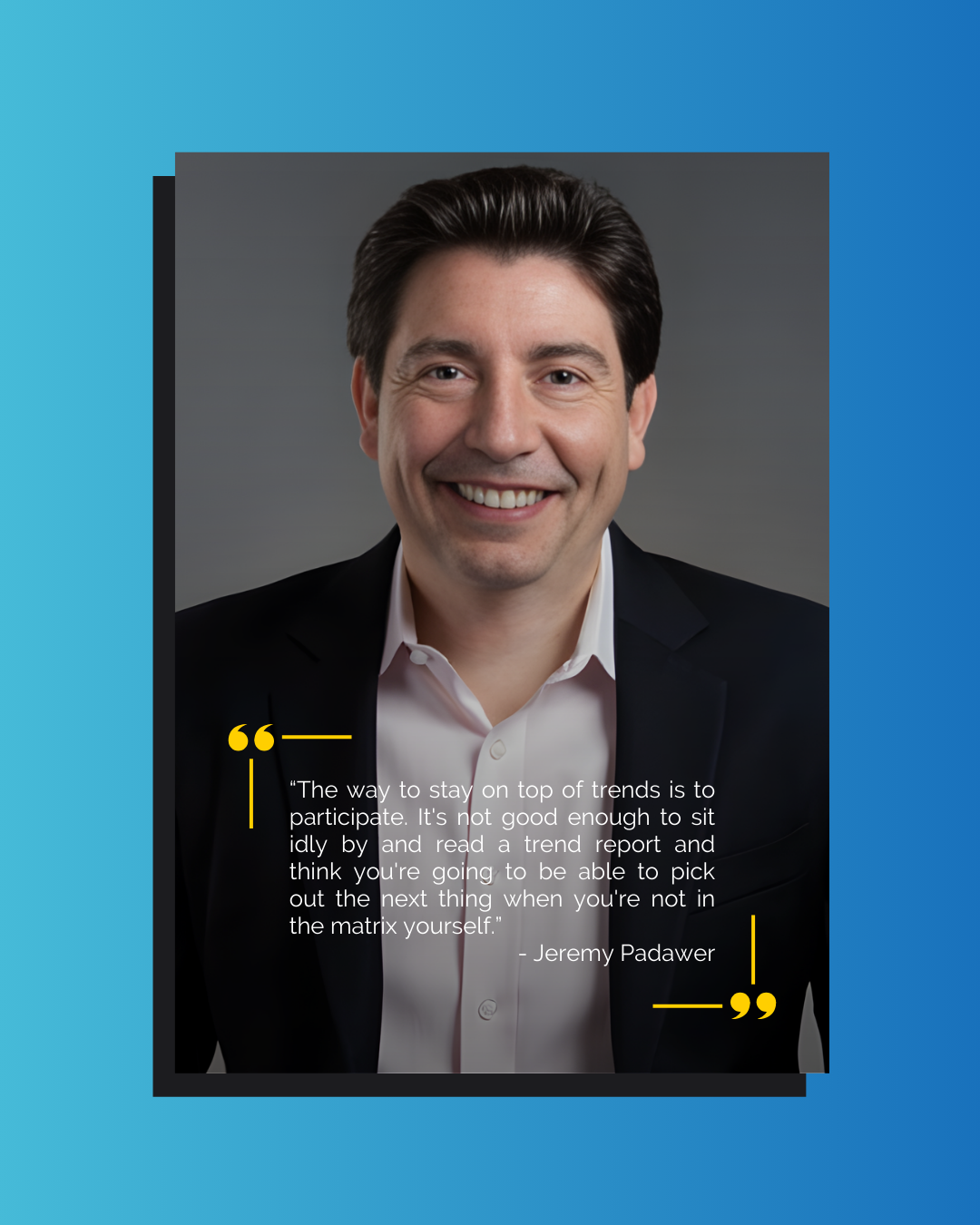
Jeremy Padawer: The way to stay on top of trends is to participate. You know, it's one thing to read trend reports. It's another thing to be buying manga and setting world records. And I will tell you this, before I had money, I did it with my brain. I would follow these things. And I would say, if I had the money, I would buy this. But then I would go buy something for $2,000 instead of $250,000. And before I had $2,000, I would buy things for $20. So, I guess what I'm saying to you is you really want to be effective in a world where there's trends and innovation. You have to participate. It's not good enough to sit idly by and read a trend report and think somehow, you're going to be able to pick out the next thing when you're not in the matrix yourself.
Greg Pan: I think in your story in particular, broadcasting that I'm going to invest significantly in this hobby, I'm going to connect with people in this hobby too. I agree 100 % that Pokémon cards would have been a collector's haven, would have gravitated towards it anyway, but because you've put it on social media, you've connected with these major influencers, you've turned that into part of the story. You've accelerated that. You've manifested that, turning that into a major collector's space. So, by broadcasting that as well is also part of it.
Jeremy Padawer: Listen, I take that as an enormous acknowledgement and I'm very appreciative that you feel that for never sold anything. The beautiful thing about the way I collect is I tend to collect and hold. Now, my wife has told me that in my mid-60s, which is 13 years from now, that I have to sell my stuff. And a fire that, was due to extraordinary negligence at the city and state level took a lot of stuff from me. I'm so grateful. Honestly, my participation in all of this, has really not been for profit from a collecting standpoint, because I never realized those profits. I just love it. And I love being part of the zeitgeist and I love being aware and it helps me professionally beyond the value of the collecting in and of itself. So, you know, I'm a pure, true blue collector, but I'm also transactional. I'm very capitalistic. I don't let any of the bad juju around it. I don't let any of the bad sort of like, you know, people see things and they say, it's bad to do this or that. I don't believe in any of that. I follow my heart; I know that I'm a decent individual and if capitalism is out of fashion, it's just how I'm wired. So, I'm in on it, but I never realized a profit. Now, on the professional side, I did quite well because I always knew something that a lot of other people didn't know. My belief is that if you follow the things that you love, you'll do better at whatever it is that you do in your career, and if I can influence people in that regard to follow their passions a little bit I would say, I would feel like I did something real with my life.
Greg Pan: That's a good point to end on. I guess one thing that's great about the field with licensing is you get that ability to touch upon these world-renowned classic nostalgic properties, as well as new ones that have a major influence on the cultural zeitgeist. So just being a part of that is always fun.
Jeremy Padawer: It is so fun, and being relevant to younger people means a lot to me because I was a kid that wanted to do things that were big and interesting. And I collected since I was three years old, my older brother introduced me to collecting at flea markets. He was 13 years older than me. He'd drive me to flea markets. He'd bought me coins and I just fell in love with all of it. It was all so interesting. And so, to influence young people and to do so and just kind of tell them the way I think, I know that the next generation is going to be acutely better than we were at this, or I was. I'm old.
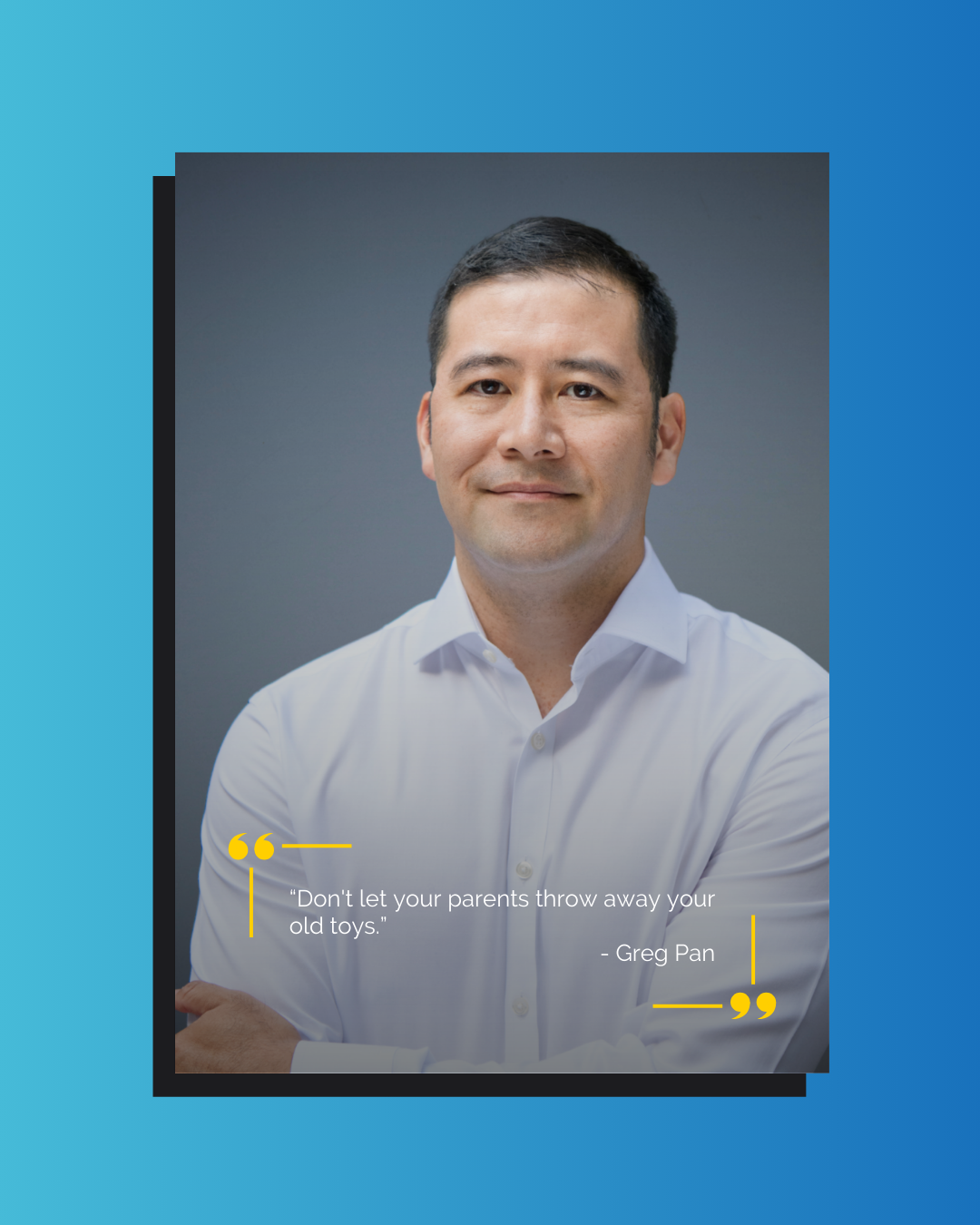
Greg Pan: That's right, don't let your parents throw away your old toys.
Jeremy Padawer: Too many, thank you for saying parents. Most people say mom. I feel like moms are wrongfully accused across the country for the actions of the dads who are demanding a clean garage or something.
Greg Pan: Or don't let your dad sell your stuff off.
Jeremy Padawer: Yeah, I really appreciate the time. I hope that this is educational for someone and I hope it inspires someone to collect or get involved in the licensing business one way the other.
David Schnider: Yeah, thank you for coming on. It was great to talk to you.
Announcer: Thanks for listening to the Licensing Exchange. If you enjoyed the show, please share with others and kindly rate and review us on your favorite podcast platform. For more information on how we can help with your own legal needs, check out our services at nolanheimann.com. That's N-O-L-A-N-H-E-I-M-A-N-N.com.