
Every Deal Is a Dance Ep. 7: From Stage to Strategy: Pamela Fisher on Reinvention and Building Creative Careers

In this episode of Every Deal Is a Dance, Mishawn Nolan sits down with Pamela Fisher — a leading talent manager whose career spans Broadway, education, agency leadership, and artist management.
Pamela traces her journey from musical theater performer to educator, entrepreneur, agent, and ultimately manager, sharing how each reinvention built on the last. She discusses identifying raw talent, nurturing creative careers, and the importance of trust, intuition, and emotional intelligence in representation.
The conversation explores:
Reinvention as a career strategy
Identifying talent beyond résumés and reels
The difference between agents and managers
Building creative businesses rooted in alignment and flow
Navigating change in a rapidly evolving entertainment industry
This episode is an insightful look at how creative instincts, business acumen, and human connection intersect in long-term career building.


Every Deal Is a Dance Ep. 7:
Podcast Transcript:
Announcer: You're listening to Every Deal Is a Dance, part of the Look Legal pods from the law firm Nolan Heimann. And now, here is your host, Attorney Mishawn Nolan.
Mishawn Nolan: I'm Mishawn Nolan and I'm co-founder and co-managing partner of Nolan Heimann LLP. Before I was a lawyer, I was a dancer and then I was a choreographer. And so, it's not surprising that my law practice reflects dance principles of alignment and flow, especially when I'm working with my clients to monetize their creative ventures. And essentially what it means is aligning your abilities with your goals while at the same time balancing structure and reinvention. I want to make growing businesses less scary and less overwhelming for creators. So, everyone I interview in this series is someone who has a story to tell about authenticity, about their reinvention and their journey as a creative business maker. It is an opportunity to hear stories of alignment and flow in action.
On this podcast I like to talk to people that are living alignment and flow, which is a methodology for building and growing creative business ventures based on dance principles. Part of the methodology requires you to identify your spot. which is the focal point you always keep your eye on so you don't get dizzy when you turn, you know which direction you're going, and it keeps you from getting lost or disoriented, especially when you're on stage with blinding lights. When someone has a clear and defined focal point, they can navigate change and handle business challenges easier. I really wanted to speak with Pamela Fisher, not only because she's one of the people closest to me in my life, but because her journey exemplifies this principle.
First, a performer, and then a teacher sharing her love for musical theater and developing talent in New York, reinventing herself as a talent agent in Los Angeles, and now a top talent manager at LBI, Pamela has overcome obstacles, swerved and pivoted, but has always been led by a guiding vision. Pamela's career is a story of reinvention, grounded in leveraging gifts, leaning into your passion, and finding new ways to express those in the marketplace.
Pamela has been credited with the careers of many Disney and Nickelodeon stars, as well as representing young adults in feature films, television, and on Broadway. Her clients include Dove Cameron, Jordan Fisher, Anna Cathcart, Matt Cornett Gabrielle Nevaeh, and Dara Renee. If you know anyone five to thirty, these actors are their superstars.
And she recently got back from New York because her client Isabella Essler is starring as Lydia in Beetlejuice on Broadway. I'm excited to explore how Pamela went from singing on cruise ships to developing the up-and-coming A-list talent of the future, including having been instrumental in developing Ariana Grande back in her Nickelodeon days. So welcome Pamela to the Every Deal Is a Dance podcast.
Pamela Fisher: Thank you. It's a pleasure to be here.
Mishawn Nolan: So, let's start at the beginning. When did you discover you were a creative?
Pamela Fisher: So, I think I was born loving to sing. I had a very musical family upbringing and I always wanted to be on Broadway. I just sort of went to theater camp. I sang in shows in school and I thought to myself, I'm just gonna be Annie on Broadway. And then that didn't happen. And so, I had to figure out, I had to pivot and I did. And I found all of these other things that I love. It led me down a path to very fulfilling career. But I think it was right from the beginning. I knew that I loved to sing and dance and that there was creativity there. I had a lot of cousins who went to Yale for mathematics and became lawyers. And I knew early on that I was different and that I was going to have a much more creative path than that. I wasn't good at math.
Mishawn Nolan: And what is it about musical theater that you just love?
Pamela Fisher: I think that there is a point when you are expressing yourself that there is no longer a way to get that feeling out other than to burst out in song. And the idea of that, the idea of feeling an emotion so passionately that you've reached a point where I can no longer express this without bursting out into song felt like something that really resonated with me. I felt that in life a lot.
I lived a lot of extremes and when I was sad, I was extremely sad. And when I was angry, I was passionately angry. And when I was happy, I felt it on a very big level. And so, for me, the idea that you could just sing and dance and get that emotion out in that creative way really was perfect for aligning with how I lived my life.
Mishawn Nolan: I know that you went to camp at Stage Door Manor in New York, and it wasreally impactful in your life. What did you learn from it? What did you take away from it?
Pamela Fisher: It was a transformative moment for me for sure because I was thrust into a world where everybody loved what I loved 24-7. That's where we immersed ourselves. And so, I think when you feel like you're a theater kid sometimes in a school system, in a public school system growing up in Brooklyn, I really didn't find where I fit in. I wasn't the sporty girl. I wasn't the academic. And so where did I fit in? And they did have a robust theater program. But when I went to theater camp at Stage Door, I really found myself. And that was a moment where everyone there loved to do what I loved to do. And I found myself there.
Mishawn Nolan: You found your people.
Pamela Fisher: I did; I found my people. It was magical for me. Everybody got it. There's somebody else who said this, so I'm stealing Todd Graff, who was also a camper and went on to produce a movie and write a movie called Camp about his experiences, loosely based on his experiences. And he said, it's like Oz. You live your life in black and white, and then you get off the bus at Stage Door and life is in color. And I very much felt that.
Mishawn Nolan: Yeah, that's beautiful. And so, you felt that you were with your people and you were performing. And then at some point you shifted to teaching and sharing this love with kids. What instigated that shift?
Pamela Fisher: It had a lot to do with my own self-realization and part of what the job is, I learned, is auditioning. That's really your job as a performer. People think it's actually shooting the film or doing the play, but those are few and far between. The actual job is auditioning and I could not make peace with the process. I didn't enjoy it. It was full of anxiety for me, and I couldn't feel authentically myself doing it. And so, I learned early on that that was not going to be the part that was going to be for me. And I really loved sharing the craft with young people. I had helped out in summer camps and I'd helped at my old middle school to choreograph things. And I realized that this could be fun. And so, a friend from camp and I started doing some musicals at her school where she was a teacher in Manhattan.
And that sort of grew and grew and grew and that became a weekend show that we would put together as a musical review and put into an off-Broadway theater, helping kids to get their first off-Broadway experience. And that became very popular in New York. And so, we opened up a second class and then a third and a fourth. And it eventually led to a full-time job where I was, you know, helping kids to learn about musical theater through the rehearsal process, and then produce them in an off-Broadway musical revue, where they get an off-Broadway credit, audiences could see them, and it was a very popular program.
Mishawn Nolan: And it wasn't just a full-time job. You were an entrepreneur. You made that business and you grew that business.
Pamela Fisher: Yeah, and I'll tell you; it was a time when you didn't see two women starting up business in New York City. And so doing that felt very fulfilling to me on many, many levels and watching it become successful felt like a wonderful and exciting realization of a dream.
Mishawn Nolan: And then you did, so you did that for about how many years?
Pamela Fisher: Twelve years.
Mishawn Nolan: Twelve years. And then you then made a huge shift and you decided to become an agent in Los Angeles. So how did you have the courage to make that change? And how did you make that shift from being a performer and a teacher, producing shows?
Mishawn Nolan: And going from that, which is one complete set of lifestyles and mindset to being an agent in Los Angeles.
Pamela Fisher: And that is something I never saw for myself. I did not imagine that. I don't think at the time that kids grew up in the 80s and 90s and went to school and said, I'm going to go to agent school or I'm going to... It just was, you know, we fall into this business for a variety of reasons. For me, I had casting directors who would come to the theater program looking for kids. And with almost alarming accuracy, I would say that one and they would book the job.
And there was a casting director in New York, in Mark Sachs, who I had gone to Stage Door with, because all roads lead back to Stage Door Manor in my life, and he said, I think you're in the wrong career. I think you should be identifying and nurturing along young talent. And he was the beginning of putting that idea in my head. And eventually I met up with some people who talked me into, there was an incredible woman in LA. who ran a young talent division and had identified the likes of Hilary Swank back in the day and a bunch of other people, including during my time with her there, I watched her with Zac Efron and launching these careers and it can be a little addictive. And so, she had offered me an opportunity and I was nervous. I was anxious. It is not easy to give up a thriving business and walk away from your own company to take a chance to move to a new city where you don't know anybody and to start over. And so, I had encouragement from friends and family, and my husband. And together we made that decision to take a leap of faith. I had a plan B that I could always start that in LA if I needed to. And I needed that for my own safety and security.
But that kind of a leap is not really my strong suit. And so, it was hard for me. I moved to LA without knowing anyone and started a job at a small agency, a boutique agency called Talent Works. And I learned from Bonnie Liedke, who was the incredible woman who had started that young talent division. And I found that it quite suited me and I quite liked it.
I started there in commercials really. It was my job to find and identify the kids and bring them in, cultivate them through commercials and then let her know when I felt they were ready for the TV and film department and usher them in there, grooming them, always grooming the talent. And that's how it started.
Mishawn Nolan: So, a lot of businesses struggle to find talent, right? That's one of the biggest challenges. Most of my clients, I speak to my clients, a lot of them, their biggest struggle is finding the right talent and building the right teams. By definition, you're a talent hunter. How do you know when you see talent? How do you identify it and how do you know that not only do they have the talent, but they have the emotional maturity to be able to handle the difficulties of this industry.
Pamela Fisher: Yeah, you don't always know. Like there's no real way for people who are dealing in older talent. You look at a reel, you see a body of work. Eight-year-olds don't come with a body of work. So, it's very much a feeling. And honestly, I have to thank Mark Sachs a lot because he did see that I had that superpower that I did not know in that I would get kind of, there's like a fire in the belly that I was attracted to that I would find myself just seeing something in these talents, in some cases that other people didn't see necessarily.
After Talent Works, I went to a larger agency. First of all, the person who I worked for at TalentWorks left, and so I stepped into her position as head of television and film. So, I had to learn that really quickly and figure that out and see what, how, that operates in a way that I could help to identify the correct talent, because it's different than commercials and what commercials looked for. And so, once I felt I was getting a handle on that, which was learning by doing in many cases, I ended up going to a larger mid-size agency called Buckwald, which was a bi-coastal agency. And I was there for four years. And after that, I went into an even larger mid-size agency called Abrams. And Abrams was really where I hit my stride.
That's where I identified Ariana Grande and Dove Cameron and Jordan Fisher and many of the people that you mentioned, many of which are with me still to this day. And I became the head of that department. Eventually I oversaw staff of five in LA and three in New York and I became a partner and a vice president at the company. And so, a lot of it was learning through that process.
I was there for 12 years. And so, I made mistakes along the way and I think you can't be afraid of that. You gotta leap in. You just have to jump in. So, I jumped in. I pretended and you know a little fake it so you make it on some parts of it and spoke to everybody that I could, met with everybody that I could in town and asked everyone's advice and their thoughts and for their wisdom and sort of put it all inside of a big bag and did my very best and I had some luck on my side.
But as far as identifying it, there is no magic way to say how I do. I look for two things. One of them is what I don't have on my list. So, if I'm noticing that they're always looking for X, Y, Z, and I don't have that to submit when casting is looking for that, then that's something for sure that I'm going to be responding to when I need it or see it in a show or if someone introduces me. And then another thing is intangible. It's something I can't put my finger on, but it is something I have been trained to respond to with pretty good luck.
Mishawn Nolan: Looking back, do you think there are any skills or experiences that you got from performing that you apply today as an agent or a manager?
Pamela Fisher: Mishawn, I really mean this. Everything I do as a manager was born in the rehearsal room. I really do think so. It's the ultimate ensemble, right? Nothing works unless everybody's working together. And as a manager, which was the next step and the next piece in the career, so I'm jumping the gun, but I'm coordinating agents and parents and coaches and casting directors and lawyers, same collaborative muscle.
I mean, and in life, musical theater is about a character's journey, right? So that's exactly how you can look at a career. What's the emotional center? What's the next beat? Where does the story go from here? So honestly, I think that the things that I learned and, you know, I continue to feel this way the things that theater teaches, the skill set is something that you can carry with you along any journey and can be helpful. I believe in any career, really and truly.
Mishawn Nolan: I completely. You know that I was a dancer and I carry that into my law practice. It's invaluable lessons having those experiences. Could you explain to people who are listening to this that don't know what is the difference between an agent and a manager?
Pamela Fisher: So, it used to be extremely easy to explain, right? The agent was the person who was procuring the jobs. They were the people who, it was very transactional. They were the people were doing the deal once that came in. And the manager, the managerial role was much more finding the talent and nurturing that along. I think you should get your hair cut. I think you should change your style or look. You need a different headshot here, so you should go to. I think that you should take this kind of class or lean into this kind of style. So, it was much more about grooming the career.
As a young talent agent, I crossed into that territory. I was extremely managerial in spirit with my clients because you are grooming a career from the start up and helping people to find that direction, and so if you look at some of the Disney and Nickelodeon talent that I represent, you can see that evolution and how they have changed over the years and change in style and look.
Mishawn Nolan: So significantly.
Pamela Fisher: And so that is something that we try to help and be part of as the career grows. Now the lines blur a lot. I know so many managers who have become agents and agents who have been managers. And so, while the things that I have to do now, you know, quite often I joke and say, I never thought I would need to know if you like an aisle seat or a window, and now I have to know that. it's more personal as a manager, and so I have enjoyed crossing into that. We don't get involved as much in the deal-making side of it. It is more about the management of overseeing the growth and of the career.
Mishawn Nolan: What has it been like for you to transition from being an agent to a manager?
Pamela Fisher: I have to know that there are a few new muscles to know with regards to scheduling clients, but I still do a lot of the things because I worked with young talent before and so much of the agenting was managerial. Sometimes I miss some of the art of the deal making process that really managers don't get as involved in that side of it.
But I do like the fact that it is less transactional and it is more personal. We walk a really weird line, right? Very strange because it is one of the few careers that's both personal and professional. And where does that line end? I mean, you saw like I had clients that my daughter’s bat mitzvahand they're over my house. What a strange job, you know, like usually if you're a doctor, you don't have your patients over for dinner. It's an unusual type of a job because we do have to get very personally involved.
Because I’m reading scripts for Jordan Fisher, I need to know what he will respond to and what he won't. I also need to know what my clients, clients have all sorts of things that they don't want to do with regards to where their moral compass is or their religious beliefs or what they don't want to play or if there’s sexuality involved. So, for me, I do have to get my hands dirty and really understand personally where they're at. And so, I enjoy that part of it because if you boil down the job of agent manager, we're in sales. We're kind of in sales. And so why wouldn't I just go sell widgets? It's because I really enjoy being very personally involved in this way. And I think when I'm on the phone with a casting director, that I “sell” quote unquote, that talent better because I know them so well because I am so personally involved and because I do know so much about what their dreams are, what they want to achieve, what their goals are. I'm so involved in it that way. So, for me, that transition to management has meant a more personal involvement and I really like it.
Mishawn Nolan: What did you not expect when you became a manager that surprised you? That was a challenge that you were just not expecting to have to deal with.
Pamela Fisher: So, you're very specific as an agent. One of the things that I did as an agent, because my eye tends to go to musical talent. So, when we were trying to put Ariana Grande onto a label, that was something that I realized there's another group that's going to step in. It's going to be a music manager and label people. And so even though I'm involved in building and helping to build this career, I'm going to have to step out of certain parts.
As a manager, you're overseeing everything and you get to see so many different sides of what we're doing. And so, at our company, I'm able to see what Dove Cameron is doing on the label and being more involved and more a part of that. I can also produce with my clients, which I've never been able to do before. I have a client, who is a director, who I work with and a writer. And during the strike, he said to me, hey, I have a strike waiver on this and I need a whole bunch of young talent, why don't you come on board and produce it with me and you'll bring all the talent.
And I thought, well, here's something new. It's not easy at this age and stage of the game to push outside your comfort zone in pursuit of new and higher opportunities. I was very comfortable at Abrams, which later became A3. In my position, I had been there for twelve years. I was a partner, a vice president, I ran the New York and LA, and had a staff.
And so, to take this leap of faith into management was not an easy move for me because it's very easy to stay in what feels comfortable. So, in leaving, I did find that there are these other opportunities that you're asking about. And that was something that I was anxious about because again, let's do something we know nothing about. And how do we learn? We're going to just do it. We're going to jump in and just do it. Ask all the people around me. Find out what I can find out, trust your instincts, and go for it. So that was unexpected, and I did find that to be really enjoyable. I liked that my opinion was being asked about things and that I was learning.
Mishawn Nolan: For a self-professed risk-averse person, you have made a lot of changes, jumped into a lot of situations that you didn't know anything about and just went for it.
Pamela Fisher: Many, many times.
Mishawn Nolan: Where did you get the courage to do that?
Pamela Fisher: I don't know, I don't know, life pushed me along. You know, I turned to friends, good friends. I mean, we discussed, think you lived through so many of these changes with me and I've lived and I've watched you do the same. And so, I've learned from the bravery of what you did and other friends who have gone out on their own to start as business women, taken a leap of faith. I think what I've learned is that change is something that you have to embrace. And while it was not something that I enjoyed, if you do business today the way that you did it yesterday, you're already a step behind. You just have to continuously change.
And so, learning to embrace it has been one of the hardest lessons of my older life, but I'm pushing myself. And I do have - I think surrounding yourself with people who helped lift you up, like my family members, my friends, coworkers, colleagues in the industry who said to me, you can do it. I have an incredible attorney who said you can do this. I have people who have done it in the past, who I've worked for and with. And so, I do think it helps to have people around you who are encouraging you. But at the end of the day, it's just something I've learned to do. And while it is still not easy, and I definitely dealt with a lot of anxiety over it. I'm not pretending that I just easily make these changes in my life. I'm happy every time that I do it. And so, I think that as you move forward, learning to embrace change, it always seems to work out for the best, it really does.
Mishawn Nolan: Yeah, we have so many clients right now that are struggling because Hollywood is undergoing such tremendous change. And a lot of people are looking at what else can I do with the skills that I have, right? Because the jobs are fewer and far between and the funding is less and the distribution models are upside down. And so, we have so many people that are looking like, okay, I have this skill, I have these capabilities. What else can I do with that?
Do you have, in addition to embracing change, do you have any other advice for someone who wants to follow a path sort of like yours, which is I have these skills and there's so many different ways I can apply them.
Pamela Fisher: I think there's an instinct really and truly that came into it. I've always trusted my instincts and my gut. And that has really guided me like from agency and to management and other things where I feel like creative careers only work when someone's willing to bet on that possibility and have the courage to sort of trust that little inner intuitive voice. And I don't know if that's something that just women have, but I do find that my female friends have that and encouraged me to listen to that. And I think listening to that helps to guide you. I really do.
Mishawn Nolan: Speaking of your inner voice and trust in your instincts, one of the things that we talk about with alignment and flow is the goal is to get into alignment so that you can then be in the flow, right? Because the flow state is the ideal state when you're working and operating. When are you in the flow?
Pamela Fisher: Gosh, mean, listen, it's an ongoing process, right? It's not like, suddenly, you know, there's going to be probably many different flows as you go along. Like you're building, you build it by figuring out what you do uniquely. And then you got to just do it unapologetically. Like you just have to figure it out and that will help you find your flow. Like what's different and unique. This is like a specialty, what I do. And there's not a lot of people in town who do it. I found that at this level there aren't a lot of managers who are finding and identifying young talent, and so that was something that I uniquely could bring to it and so I think finding something that uniquely for you helps you get into the flow that way.
Mishawn Nolan: When you're doing something that is really true to your authentic passions and skills, and because what you do today is really rooted in, if you go back to the beginning, the performing, the working with kids, the developing talent, the developing the interest in musical theater. I mean, it's a through line, straight through.
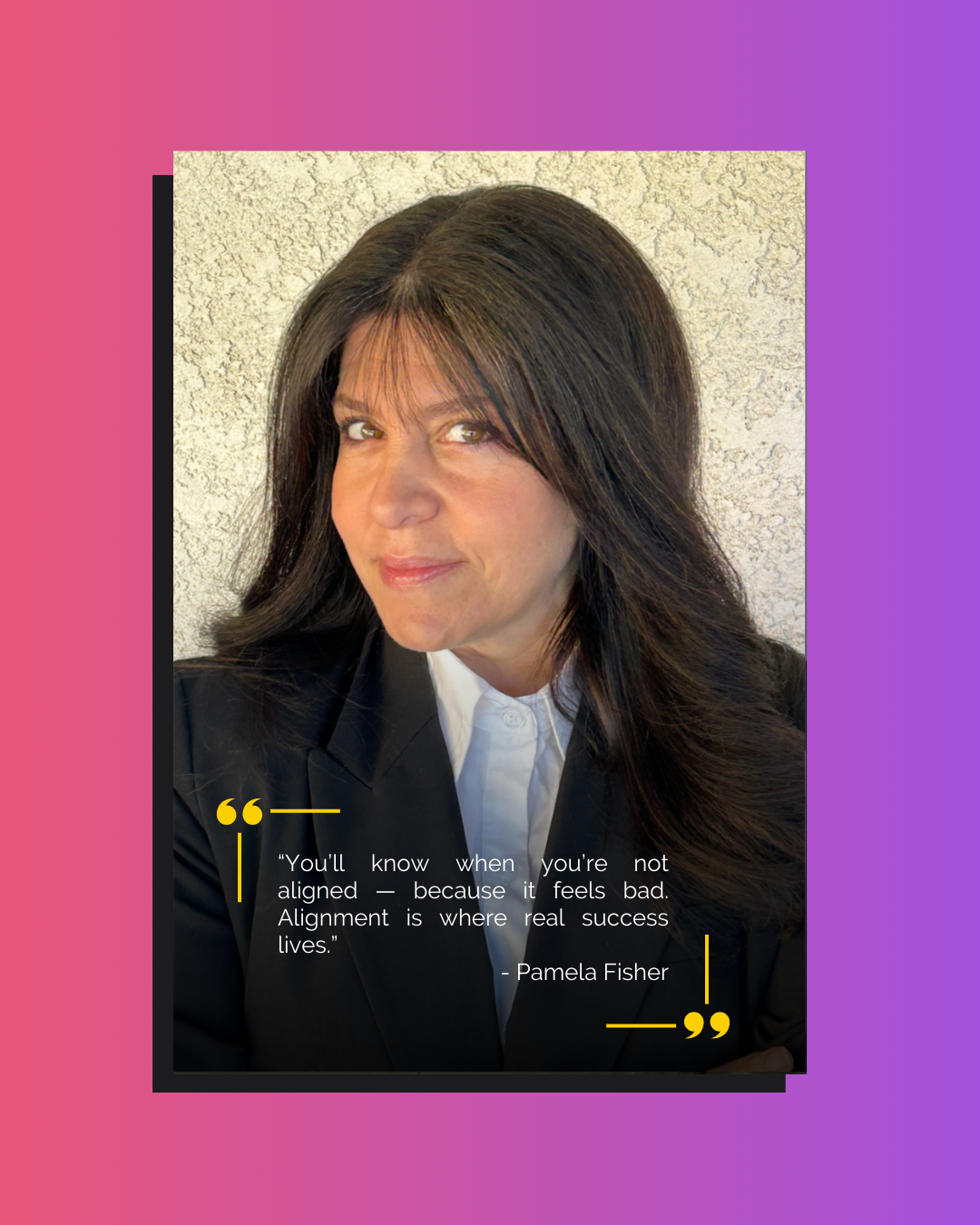
Pamela Fisher: While I didn't see it for myself, I think that what you're hitting on that's really, really important that I didn't mention is that you'll know when you're not aligned in your flow because it feels bad. It doesn't feel good. And I know what that feels like. I have woken up, you know, on a Sunday thinking tomorrow's Monday and just dreading it. It doesn't feel good. And I don't think that people necessarily can succeed in business when they're in that place, because that to me is like blocking that wonderful flow and alignment that you're talking about. But I understand we all have to do things sometimes… I've waited tables. done like I've done what I had to do, because you have financial needs or what other types of needs you may have in your life. But I do think if you're seeking something uniquely authentic for yourself, you will know and you will be most successful. when you are living in the place of joy. And I'm not just saying that every single moment of my life is joy because there's times when a Monday morning still feels like a Monday morning. But in general, I wake up very excited to face the day of my job. I think about what I do throughout the weekends and the evenings. I think about my clients. I care about the work that I do. It feels authentic to me and I'm excited about it and live in a joyful place about it and I do think that that is going to be key to the flow without question.
Mishawn Nolan: One hundred percent. So, everything you do is - really the seed of everything is creativity. With what you do, it's a very giving and nurturing job. How do you keep your creativity alive?
Pamela Fisher: So, I'm allowed to be a part of all of these things, right? I'm allowed to read the scripts and visit the sets. And so that feeds a lot of the creativity. I also do things on the side. I assist my husband, who's an actor, is also a director of a program and after-school musicals. And so, I keep my hand in that. I will help him write a show or a musical revue, go and visit. I think giving back is always an important. I'll sit on panels. I go to see young talent perform constantly. Anything that's for education. I'm going to see a high school show tonight. My daughter is not in the show. I'm just going to see it. I consistently do that. I think it keeps me aligned, to use your word, with what's going on in the industry.
It reminds me of the passion, you know, being there at the beginning of a career, when that dream is still so young and fresh and untainted by this crazy business. It really keeps you going because you remind, you know, kids don't do theater…and even when I put kids in movies and they're going to make a lot of money, they don't know, they don't know, they don't have to put food on the table or buy health insurance. They do it because they love it. They have to, they're compelled to, right? They're not doing it for the money. They're not going to see that money until they're older and get their Coogan account or what have you, but they're doing it for the pure joy and passion of what they do. And so that continues to keep me creatively involved. And I feel like I'm creative every single day, picking material, picking projects, reading about projects, and hopefully taking projects to, to new heights, which I am able to do as a manager and was not able to before. And so, I think this was really a perfect job for me that I just didn't know existed.
So, it's really good to encourage people to try and look for because there's jobs you don't even know exist out there that could really suit your skill set.
Mishawn Nolan: All right, well, thank you, Pamela, very much. Thank you for sharing your story. I really appreciate it.
Pamela Fisher: Thanks, this was a pleasure. What fun.
Announcer: Thanks for listening to Every Deal Is a Dance. If you've enjoyed the show, please share with other creative business makers and kindly rate and review us on your favorite podcast platform. For more information on how we can help with your own legal needs, check out our services at nolanheimann.com. That's N-O-L-A-N-H-E-I-M-A-N-N.com.